BMW's Bold Move: Humanoid Robots Join the Manufacturing Revolution in Europe
BMW's Bold Move: Humanoid Robots Join the Manufacturing Revolution in Europe
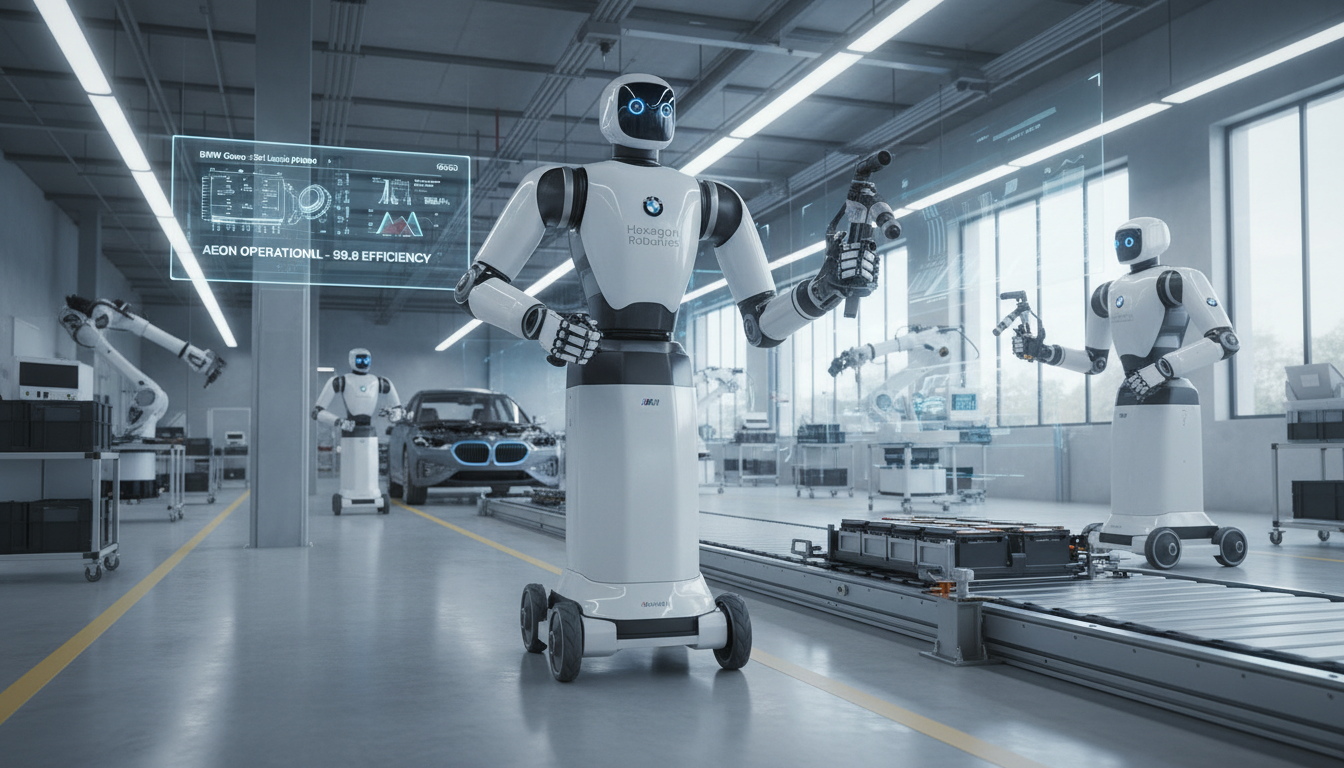
In a groundbreaking development, BMW Group has taken a significant leap forward in advancing the use of humanoid robots for manufacturing processes in Europe. The company's Leipzig plant in Germany has become the testing ground for AEON, a state-of-the-art humanoid robot developed by Hexagon Robotics. This deployment marks a pivotal moment for European industry, signifying a move towards integrating physical artificial intelligence (AI) in manufacturing, an area previously dominated by North American and East Asian markets.
The Introduction of AEON
AEON, the humanoid robot introduced by BMW, is not just a marvel of engineering but a practical tool designed for efficiency and productivity on the factory floor. Unlike the typical humanoid robots that captivate audiences with their dancing capabilities, AEON is engineered with a focus on industrial applications. It navigates on wheels rather than legs, optimizing mobility and energy consumption on the plant's flat surfaces. Standing at 1.65 meters tall and weighing 60 kilograms, AEON is built for around-the-clock operation, capable of autonomously swapping its battery in a mere 23 seconds.
Advanced Capabilities
What sets AEON apart is its comprehensive suite of 22 integrated sensors, including peripheral cameras and infrared technology, which provide it with full 360-degree spatial awareness. This enables AEON to perform quality inspections and other complex tasks that stationary robots cannot handle. Its adaptable torso allows for a variety of tools and grippers to be attached, making it versatile for different production tasks.
Strategic Deployment
The rollout of AEON at the Leipzig plant was carefully planned and executed. The initial test deployment occurred in December 2025, with further tests scheduled for April 2026. By summer 2026, BMW plans to have two AEON units working simultaneously on high-voltage battery assembly and component manufacturing for exterior parts. Leipzig is a strategic choice for this pilot due to its comprehensive technological setup, encompassing various production processes under one roof.
Institutional Support and Infrastructure
To support this ambitious project, BMW has established a Centre of Competence for Physical AI in Production. This center consolidates expertise across the company and provides a structured pathway for evaluating and implementing new technologies. The infrastructure supporting AEON is robust, with BMW having dismantled data silos in favor of a uniform data platform. This ensures consistent and accessible information, enabling AI agents like AEON to operate autonomously and improve continuously.
The Broader Impact
BMW's initiative is more than just a technological advancement; it is a statement about the future of manufacturing. According to Deloitte's State of AI in the Enterprise 2026 report, 58% of companies are already using physical AI, and this number is expected to grow to 80% within two years. BMW's Leipzig pilot serves as a crucial proof point that humanoid robots can meet the rigorous demands of industrial production.
A New Era for European Manufacturing
The successful deployment of AEON at BMW's Leipzig plant could have far-reaching implications for the European manufacturing sector. It challenges other industries to rethink their production strategies and consider integrating humanoid robots. The question is no longer whether these robots have a place on the factory floor, but rather how quickly other manufacturers will follow BMW's lead.
Conclusion
BMW's introduction of humanoid robots in its manufacturing processes is a bold and forward-thinking move that highlights the transformative potential of physical AI in industry. As AEON continues to prove its capabilities, it sets a new standard for efficiency and innovation, paving the way for a new era in European manufacturing. This initiative not only positions BMW as a leader in technological advancement but also signals a shift towards a more integrated and automated future for the industry as a whole.