Bridging the Gap: Why Your Enterprise AI Needs Both a Semantic and Context Layer
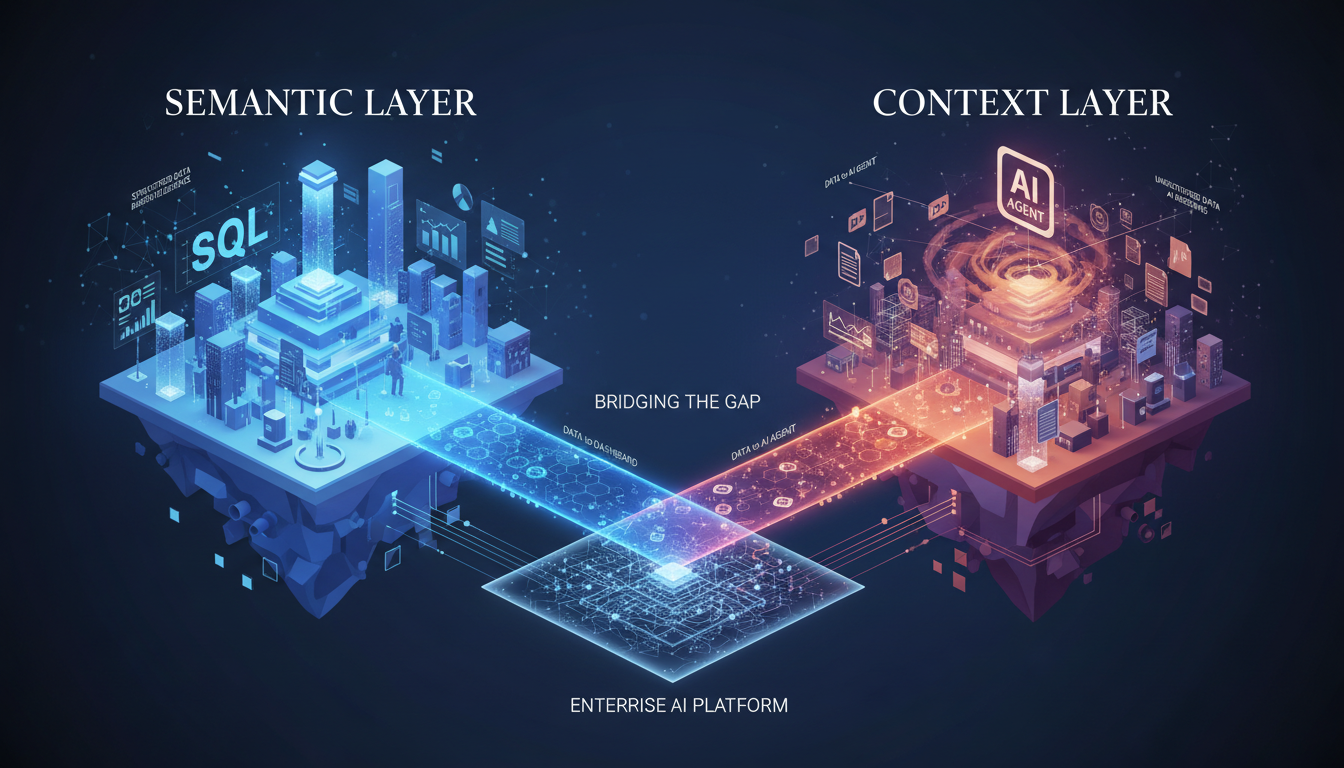
Bridging the Gap: Why Your Enterprise AI Needs Both a Semantic and Context Layer
As enterprises continue to integrate artificial intelligence (AI) into their operations, the importance of both semantic and context layers is becoming increasingly evident. While both layers aim to make data more accessible and useful, they serve distinct but complementary purposes. Understanding these differences is crucial for any organization looking to fully leverage AI capabilities.
Understanding the Semantic Layer
The semantic layer is an abstraction that translates complex database schemas into business-friendly terms. Originating in the early 1990s, this layer was designed to make structured data understandable to business intelligence (BI) tools. It plays a key role in ensuring consistent metric definitions across various BI platforms, enabling users to generate reports and dashboards without needing to understand SQL or complex data structures.
By mapping cryptic database terms to more intuitive labels, the semantic layer allows business users to interact with data more effectively. Its resurgence in recent years, fueled by platforms like dbt Labs and their acquisition of Transform, has solidified its place as essential infrastructure for analytics. This layer excels in environments where data is structured, providing a consistent foundation for KPI reporting and other BI tasks.
Introducing the Context Layer
While the semantic layer handles structured data effectively, it falls short when dealing with unstructured data, which comprises 80–90% of enterprise information. This is where the context layer comes into play. Unlike the semantic layer, the context layer is designed to make all types of data—structured and unstructured—usable by AI agents.
The context layer provides AI with the ability to reason over complex, multi-document knowledge bases. It answers broader questions such as the relevance of information to a task, applicable rules and constraints, and the best way to use organizational knowledge to generate a grounded response. This layer is essential for industries where critical information exists in unstructured formats like PDFs, legal documents, and technical specifications.
Structured vs. Unstructured Data
The limitations of the semantic layer become apparent when the data does not fit neatly into rows and columns. While it is adept at handling structured data in SQL-queryable formats, it cannot process unstructured content like engineering specifications or legal contracts. This is problematic in sectors such as manufacturing, legal, and financial services, where much of the essential knowledge is unstructured.
The context layer addresses this gap by incorporating document processing, retrieval systems, and grounding mechanisms. Techniques like Retrieval-Augmented Generation (RAG) allow AI to access and reason over relevant information in real-time, ensuring responses are traceable back to original documents.
Real-World Use Cases
The distinct roles of semantic and context layers become evident through practical applications. The semantic layer is ideal for scenarios requiring consistent KPI reporting, self-service analytics, and text-to-SQL interfaces. It performs well in environments where data is tabular and structured queries are sufficient.
In contrast, the context layer is indispensable for AI applications that need to navigate and synthesize information from unstructured sources. For instance, in a semiconductor company, while the semantic layer aids financial teams in generating revenue reports, the context layer empowers engineers to resolve technical issues swiftly by providing access to relevant datasheets and internal documents.
Similarly, in the legal domain, while a semantic layer might track contract values, a context layer enables AI to analyze contracts, identify potential conflicts, and ensure compliance with new regulations.
The Need for Both Layers
Enterprises are increasingly required to deploy AI solutions that go beyond the capabilities of traditional BI infrastructure. While the semantic layer remains vital for structured data governance, it is not sufficient for enabling AI agents to process unstructured data at scale. Organizations that succeed in deploying advanced AI will be those that build a complementary context layer alongside existing semantic frameworks.
The semantic layer bridges the gap between databases and dashboards, while the context layer extends this bridge to AI agents, allowing them to reason across the full spectrum of organizational knowledge.
Conclusion
For enterprises to fully realize the potential of AI, both semantic and context layers are necessary. These layers are not competitors but allies, each addressing different facets of data processing and AI integration. By embracing both, organizations can ensure that their AI initiatives are not only comprehensive but also capable of reasoning and decision-making at an unprecedented scale. As AI continues to evolve, the synergy between semantic and context layers will be key to unlocking transformative business insights and efficiencies.