Mastering Context Engineering: The Key to Unlocking AI's True Potential
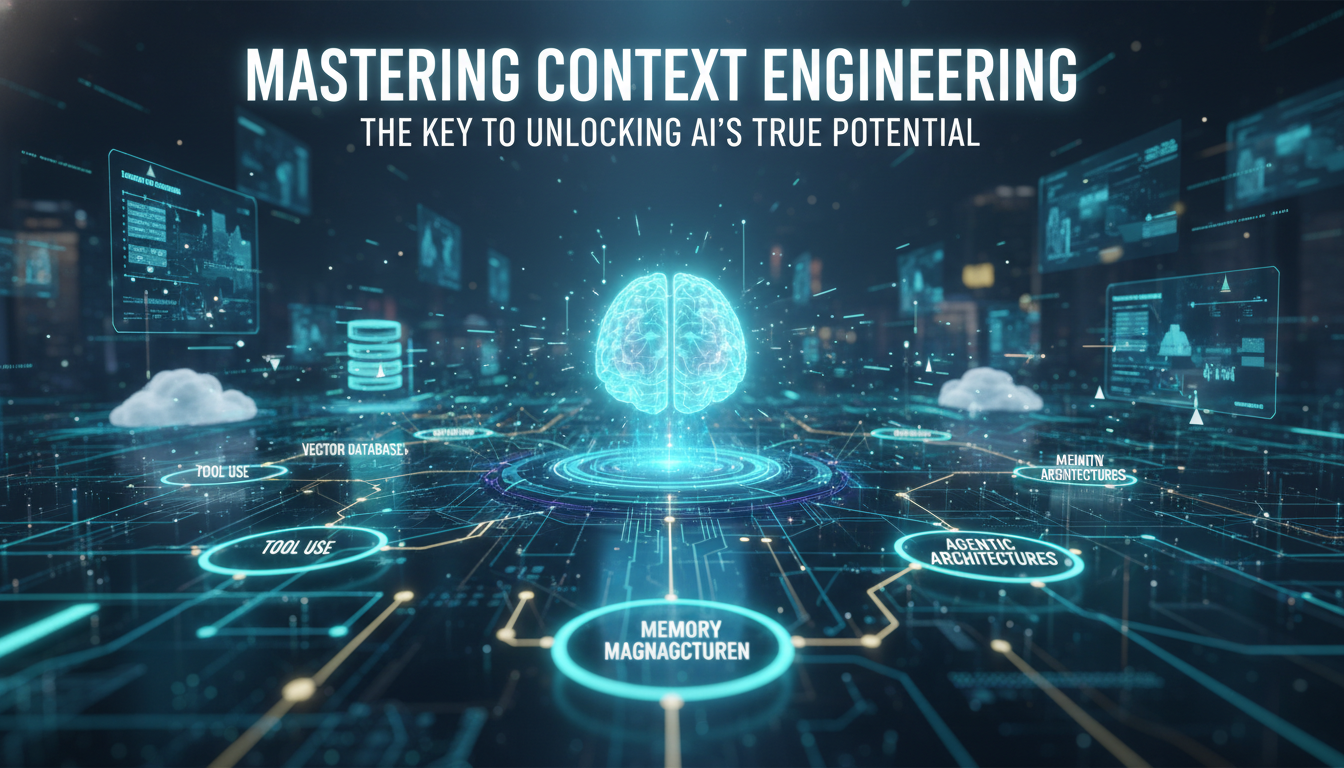
Mastering Context Engineering: The Key to Unlocking AI's True Potential
As advancements in Large Language Models (LLMs) continue to accelerate, the demand for innovative applications that harness their capabilities is growing exponentially. These applications are evolving from simple text generation tasks to driving actions and facilitating decision-making processes. However, this shift introduces new complexities, particularly in managing the vast array of information these models must process. Enter context engineering: a crucial methodology that optimizes the integration and utilization of data within AI systems.
Understanding Context Engineering
Context engineering refers to the strategic organization and management of information that an AI model requires to perform tasks accurately and efficiently. It encompasses several techniques aimed at ensuring that the necessary information is readily available to the model, thus preventing erroneous outputs or "hallucinations." These hallucinations often occur when a model relies solely on its embedded knowledge without contextual grounding, leading to inaccurate or irrelevant responses.
The core components of context engineering include:
- Tool Use: Enabling AI to utilize external tools to perform specific actions.
- Prompt Engineering: Crafting precise instructions for the model to follow.
- Retrieval: Accessing and integrating relevant data related to the task.
- Memory Management: Storing and recalling historical data and interactions.
- Agentic Architectures: Managing outputs from various sub-agents and tools.
These elements must cohesively fit within the limited context window of an AI model to ensure seamless application performance.
Challenges and Solutions in Context Engineering
One of the primary challenges in context engineering is managing the fixed attention span of AI models while dealing with multiple data sources and objectives. Without effective context management, models may revert to their general world knowledge, resulting in less accurate responses. This is where retrieval and vector databases become invaluable, as they help retrieve and organize the external information necessary for grounding the model’s responses.
To address these challenges, context engineering involves organizing, filtering, and processing data to maintain the model's focus on the task at hand. Techniques such as summarization and reranking are employed to refine the set of relevant documents, reducing the risk of hallucinations and enhancing response accuracy.
Applying Retrieval-Augmented Generation (RAG) Concepts
For those familiar with retrieval-augmented generation (RAG) applications, many principles of context engineering will already be recognizable. RAG involves using external data to refine AI outputs, a concept that directly informs context engineering practices. For instance, when developing an AI-driven customer support application, RAG principles can help balance the retrieval of relevant documents with the model's response generation.
In a practical setting, an AI-powered customer support agent might leverage a knowledge base containing previous support tickets and company documentation. The agent uses this context to address user queries effectively. However, the challenge lies in evolving this system into a more sophisticated agent that can not only respond but also manage support tickets, maintain conversations, and route tasks to appropriate personnel.
Building Agentic Architectures
Transitioning from a single-agent model to a multi-agent architecture can significantly enhance the efficiency and responsiveness of AI systems. By delegating tasks to sub-agents, an AI system can handle multiple actions simultaneously, reducing latency and improving user experience.
However, maintaining context across multiple agents presents its own set of challenges. Careful engineering is required to ensure that context is preserved and utilized effectively throughout the agent network. This involves continual refinement of data handling processes, ensuring that each agent can access the necessary information to perform its designated tasks.
The Future of Context Engineering
Mastering context engineering is essential for developing advanced AI applications that deliver consistent and accurate results. As AI continues to evolve, the ability to effectively manage and utilize context will become increasingly important. By embracing the principles of context engineering, developers can create AI systems that not only respond to user queries but also anticipate and adapt to complex tasks.
As we continue to push the boundaries of what AI can achieve, context engineering will remain a foundational practice, unlocking new possibilities and enhancing the capabilities of intelligent systems.