Navigating the Maze: Understanding AI Model Deployment in Production
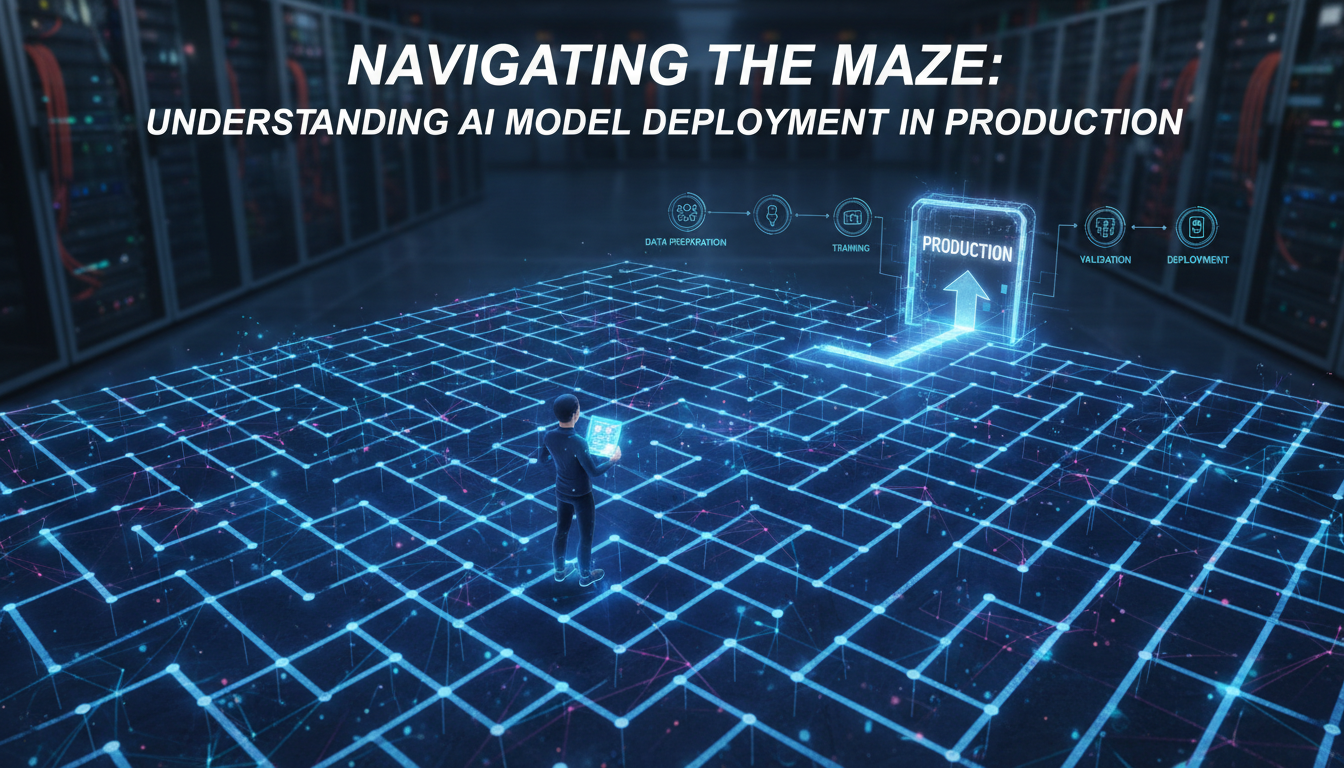
Navigating the Maze: Understanding AI Model Deployment in Production
Deploying an AI model into production is a critical yet often misunderstood aspect of data science and machine learning. For many, the journey from a model's conception to its deployment involves navigating a complex maze of technical and organizational challenges. This article aims to demystify the process, offering a clear roadmap for successfully deploying machine learning models in a production environment.
What Does Production Mean?
In the realm of machine learning, putting a model "in production" signifies that its outputs have a direct impact on users or products. This impact could be as varied as enhancing decision-making, enabling new capabilities, or improving user experiences within applications. Beyond generating impact, a model in production must also be accountable; it should have mechanisms for error correction and reliability to maintain trust and functionality.
Despite its importance, a significant number of machine learning projects—reportedly up to 87%—never reach this stage. Many models fail to deliver tangible benefits due to a lack of systems ensuring their reliability over time. Therefore, understanding what production entails and how to achieve it is crucial for any team working with AI.
The Complex Ecosystem of Production
Production is not a monolithic concept; it encompasses various components beyond the machine learning model itself. While it’s easy to envision a model as a standalone entity, it is typically integrated into a broader data pipeline. This pipeline involves data storage, acquisition, transformation, and, finally, the machine learning component itself.
Data Storage Systems: Data must be stored securely, often in cloud environments or on-premise databases, forming the backbone of production systems.
Data Acquisition: This involves establishing workflows that connect to these databases, retrieving and preparing data for model input.
Deployment of Machine Learning Models: This is the step where the model, already trained, is integrated into the existing environment to function alongside other system components.
The integration of these elements highlights that deploying machine learning models in production is as much about managing the surrounding infrastructure as it is about the model itself.
Breaking Down the Deployment Process
Step 1: The Function
The journey begins with a trained model encapsulated in a function. This function should load the model, accept input data, make predictions, and return outputs. It’s essential to ensure this function handles errors gracefully, as real-world data can be unpredictable with missing values or corrupted inputs.
Step 2: The Interface
To make the function accessible, an interface, typically an API, is necessary. This allows other systems to interact with the model seamlessly. The interface acts as a contract, ensuring consistent communication protocols. Misalignment here can lead to friction and integration issues.
Step 3: The Environment
Portability is key. The model, along with its dependencies, needs to be packaged so it can run in different environments without modification. Tools like Docker facilitate this by encapsulating everything in a container, ensuring consistency across deployments.
Step 4: The Infrastructure
Hosting the model where it can be accessed by users and applications is the next step. This often involves cloud platforms, but could also include internal servers or edge devices. The choice of infrastructure should consider factors like latency, cost, and security.
Step 5: The Monitoring
Finally, monitoring is crucial for maintaining a model’s effectiveness over time. It involves tracking service uptime, input data consistency, output accuracy, and overall business impact. Without monitoring, a model in production is vulnerable to unnoticed performance degradation.
Practical Guidelines for Success
For Step 1, utilize familiar tools such as scikit-learn or TensorFlow, but consider future automation and portability. Step 2 should focus on consumer needs, ensuring API endpoints and data schemas are stable. In Step 3, understanding Docker basics is essential for environment portability. When considering Step 4, infrastructure constraints will guide your choice of hosting solutions, while Step 5 emphasizes the importance of setting up robust monitoring systems.
Conclusion
The path to deploying AI models in production is not a single milestone but a series of steps requiring a shift in mindset. It’s about building models that not only meet technical specifications but also answer business needs and integrate seamlessly into production ecosystems. By following these guidelines, you can ensure your models don’t fall into the 87% that never achieve real-world impact.
Understanding the complexity and requirements of production environments is vital for any data science team. While tools and methodologies may vary across organizations, the principles of effective deployment remain consistent. Ultimately, a successful deployment is one that is not only technically sound but also aligned with business objectives and user needs.