Revolutionizing AI: ASML's High-NA EUV Tools Set to Transform Chip Production
Revolutionizing AI: ASML's High-NA EUV Tools Set to Transform Chip Production
The landscape of artificial intelligence is on the brink of a significant transformation, driven by advancements in semiconductor manufacturing. At the heart of this revolution is ASML's High-NA EUV tools, which promise to redefine the capabilities of AI chips. These state-of-the-art machines are poised to break through existing technological ceilings, enabling the production of more powerful and efficient AI hardware.
The Breakthrough in Chip Manufacturing
ASML, a leader in the field of photolithography, has unveiled its High-NA EUV (Extreme Ultraviolet) lithography tools, marking a critical milestone in semiconductor technology. These tools are designed to produce chips with finer and denser circuit patterns, a necessity for the advanced AI applications of tomorrow. With current EUV machines nearing their performance limits, High-NA EUV tools represent the next leap forward, offering unprecedented precision in chip manufacturing.
Current-generation EUV technology has been instrumental in advancing AI capabilities, but it is rapidly approaching its physical limits. High-NA EUV tools are engineered to surpass these constraints, allowing chipmakers to create more powerful and efficient processors. This leap in technology is essential for the continued evolution of AI, particularly in applications requiring significant computational power, such as large language models and AI accelerators.
Key Metrics of Readiness
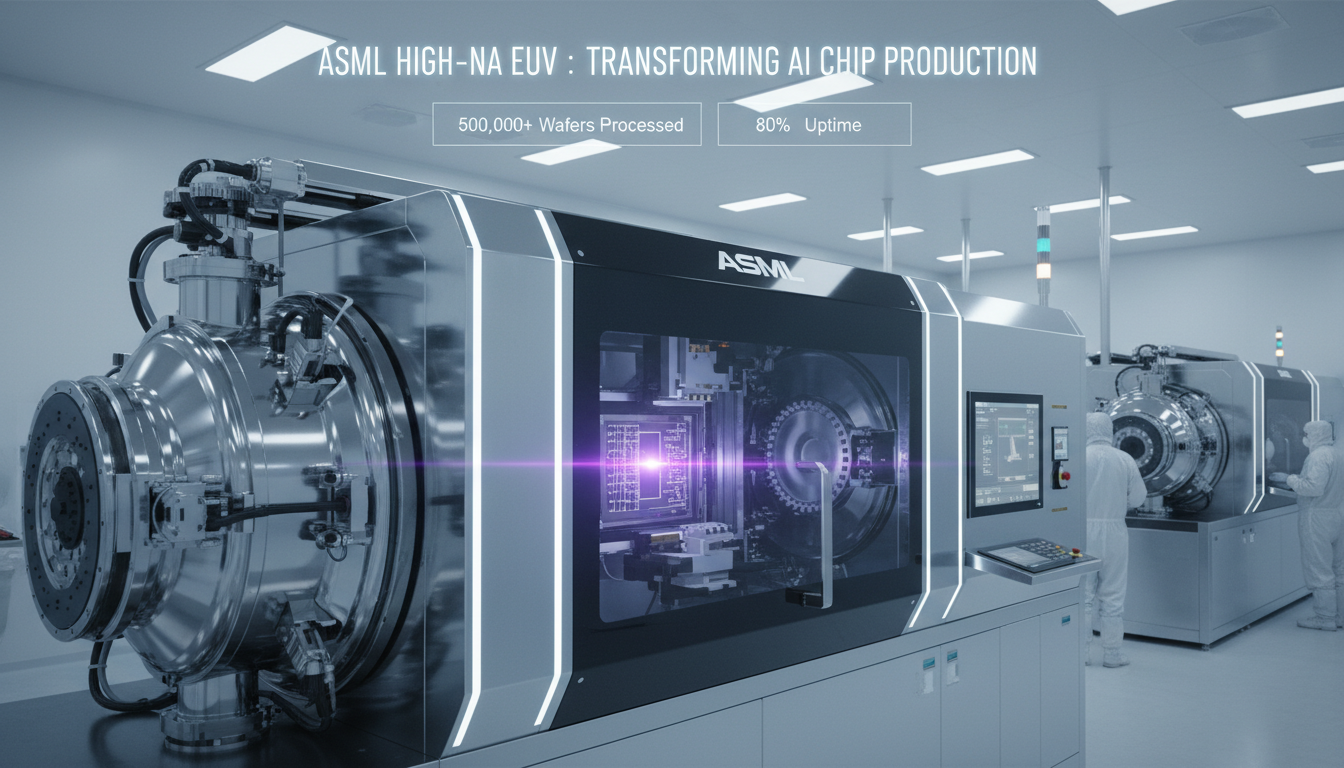
ASML's announcement of the High-NA EUV tools' readiness for mass production is backed by impressive metrics. The tools have successfully processed over 500,000 silicon wafers, a testament to their reliability and efficiency. Additionally, they have achieved an uptime of approximately 80%, with expectations to reach 90% by the end of the year. Most notably, these tools have demonstrated the ability to replace multiple conventional patterning steps with a single High-NA pass, significantly enhancing production efficiency.
These metrics are not just numbers; they represent a tangible shift in the manufacturing landscape. The ability to achieve such high levels of precision and reliability indicates that High-NA EUV tools are ready for widespread adoption by chip manufacturers. However, this technological advancement comes at a cost. Each unit is priced at around $400 million, making them one of the most expensive pieces of industrial equipment ever created.
Adoption by Industry Leaders
Prominent industry players like TSMC and Intel are among the early adopters of ASML's High-NA EUV tools. Their involvement underscores the importance of this technology in shaping the future of chip production. As these companies begin to integrate the new tools into their production lines, the industry is set to witness a transformation in chip capabilities, further fueling the growth of AI applications.
While the tools are technically ready, full integration into production lines is expected to take two to three years. This timeline reflects the complexity of qualifying and adapting these cutting-edge machines for high-volume manufacturing. Despite the challenges, the industry is poised to embrace this technological evolution, driven by the promise of enhanced chip performance.
The Implications for AI Development
The introduction of High-NA EUV tools is set to have far-reaching implications for AI development. By enabling the production of more advanced chips, these tools will facilitate the creation of AI systems with greater processing power and efficiency. This advancement is particularly crucial for applications that demand high computational capabilities, such as autonomous driving, real-time language translation, and complex data analysis.
Moreover, the increased efficiency and precision in chip manufacturing will likely lead to cost reductions over time, making advanced AI technologies more accessible to a broader range of industries. As a result, we can expect to see AI being integrated into an even wider array of applications, driving innovation and growth across sectors.
Conclusion
ASML's High-NA EUV tools represent a pivotal moment in the evolution of semiconductor technology. By pushing the boundaries of what is possible in chip manufacturing, these tools are set to unlock new levels of performance and efficiency in AI applications. As the industry moves to integrate this cutting-edge technology, the future of AI looks brighter than ever, promising to reshape industries and enhance our daily lives with smarter, more capable technologies.