Revolutionizing Manufacturing: How Physical AI Simulation is Boosting ROI
Revolutionizing Manufacturing: How Physical AI Simulation is Boosting ROI
In the evolving landscape of manufacturing, technological advancements are forging pathways to efficiency and precision previously thought unattainable. Among these innovations, physical AI simulation is emerging as a transformative force, particularly in the realm of factory automation. This article delves into how physical AI simulation is closing the gap between digital models and real-world applications, ultimately boosting return on investment (ROI) for manufacturers.
Bridging the Digital-to-Physical Divide
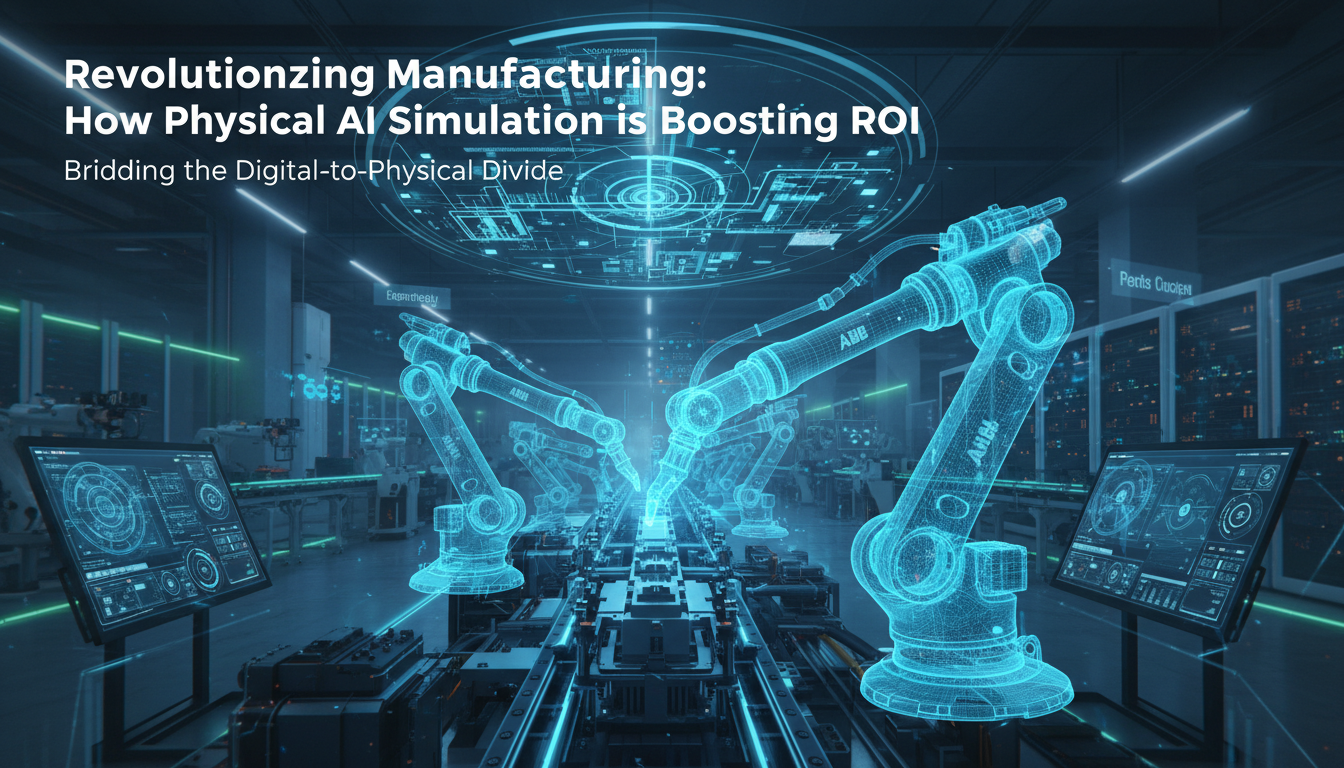
Manufacturers have historically grappled with the challenge of translating intelligent robotics from controlled environments to the unpredictability of factory floors. The disparity between digital training models and physical production environments has often necessitated costly and time-consuming physical prototyping. However, the partnership between ABB Robotics and NVIDIA is poised to revolutionize this process.
By integrating NVIDIA's Omniverse libraries into ABB's RobotStudio software, a new frontier in simulation is being unlocked. This collaboration offers a platform for highly accurate digital testing, enabling manufacturers to design, test, and validate automation cells virtually before physical deployment. This approach not only streamlines the production process but also significantly cuts deployment costs and accelerates time to market.
Enhancing Precision with Advanced Simulation
A key feature of this simulation technology is its ability to emulate real-world conditions with remarkable accuracy. The system exports a fully parameterized station—complete with robots, sensors, lighting, and parts—into a digital environment. Here, a virtual controller mimics the firmware of the physical machines, achieving a 99 percent behavioral match.
This high-fidelity simulation allows for the fine-tuning of automation processes, reducing positioning errors from 8-15 mm to approximately 0.5 mm. Such precision is crucial for industries where minute discrepancies can lead to significant operational challenges.
Real-World Applications and Benefits
Early adopters of this technology are already reaping the benefits. Foxconn, a leader in consumer device assembly, is utilizing the software to handle frequent product changes and intricate components with greater accuracy and efficiency. By generating synthetic data for training purposes, Foxconn can anticipate a reduction in setup time and eliminate the need for expensive physical testing.
Similarly, Workr, an automation provider, is integrating its platform with ABB hardware trained via Omniverse. This integration allows for the rapid onboarding of new parts without specialized programming skills, showcasing the potential for broader applications across various sectors.
Expanding the Hardware Ecosystem
The partnership is also fostering advancements in edge computing. ABB is exploring the integration of NVIDIA’s Jetson edge platform into its Omnicore controllers. This development promises to enhance real-time inference capabilities across existing robotic fleets, further optimizing manufacturing processes.
The shift towards digital-first simulation is not merely about technological enhancement; it represents a strategic advantage. By reducing setup and commissioning times by up to 80 percent, manufacturers can maintain a competitive edge in a fast-paced market.
Preparing for a Digital-First Future
As AI continues to transition from software applications to hardware operations, the importance of preparing data pipelines and upskilling engineering teams cannot be overstated. Manufacturers that embrace these changes will be better positioned to leverage the full potential of physical AI simulation.
In conclusion, the integration of physical AI simulation into manufacturing processes is not just a technological upgrade; it is a strategic imperative. By bridging the gap between digital models and physical realities, manufacturers can achieve unprecedented levels of precision and efficiency, ultimately boosting ROI and driving industry innovation. As this technology continues to evolve, its potential to reshape manufacturing landscapes becomes increasingly apparent, heralding a new era of industrial advancement.