Revolutionizing Retail: How Shopify's Agentic AI is Transforming Enterprise Commerce
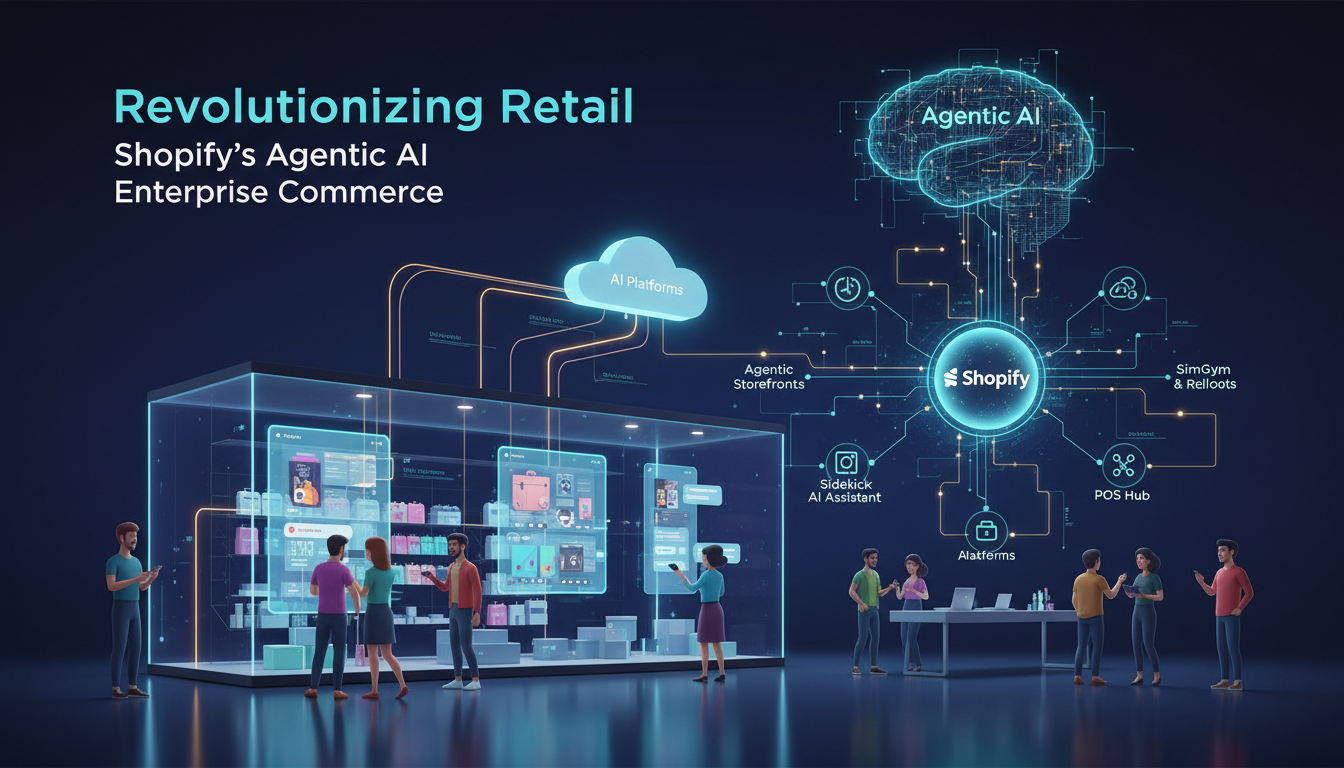
Revolutionizing Retail: How Shopify's Agentic AI is Transforming Enterprise Commerce
In the rapidly evolving landscape of enterprise commerce, Shopify stands out as a pioneering force. With its Winter '26 Edition, aptly named Renaissance, Shopify introduces agentic AI—an innovative approach that is set to redefine how businesses engage with customers, manage operations, and expand their market reach.
The Rise of Agentic Storefronts
Shopify's most groundbreaking development is the introduction of 'Agentic Storefronts'. Traditionally, retailers have relied on driving traffic to their own websites to convert visitors into buyers. However, the rise of conversational AI platforms such as ChatGPT and Microsoft Copilot is changing the dynamics of customer engagement. In this new model, products are seamlessly integrated into AI-driven conversations, allowing users to discover and purchase items directly within the chat interface.
This shift necessitates a rethinking of channel strategies for Chief Digital Officers (CDOs). Instead of building complex integrations for each external platform, Shopify's system allows products configured in the admin dashboard to be instantly discoverable by AI agents. This development ensures that brands remain visible even as consumer search behavior shifts towards large language models (LLMs).
Enhancing Operational Efficiency with AI
Beyond enhancing customer interactions, Shopify's updates to its AI assistant, 'Sidekick', focus on streamlining operations and reducing costs. Sidekick has matured from a reactive chatbot into a proactive system capable of executing intricate administrative tasks. It now provides personalized task suggestions based on real-time data, such as recommending product bundles or identifying compliance issues.
For technical teams, this evolution translates into a reduction in low-level ticket volumes. Non-technical staff can now create custom admin applications using natural language prompts, eliminating the need for developer intervention. Additionally, Shopify has introduced 'Working Flow' automations, allowing for the creation of processes without requiring deep knowledge of complex logic syntax.
SimGym and Rollouts: Innovating Testing and Experimentation
One of the persistent challenges in enterprise retail is experimenting with changes without disrupting live revenue streams. Shopify addresses this with the introduction of 'SimGym' and 'Rollouts'. SimGym uses AI shopper agents to simulate traffic and purchasing behaviors, enabling merchants to model the impact of storefront changes using synthetic data. This approach provides insights without waiting for live A/B test results.
Complementing this, Rollouts offer native experimentation capabilities within the Shopify admin. This feature allows for controlled, data-informed changes, reducing risk while enhancing decision-making processes. For executives, this means a lower risk profile for platform updates and marketing experiments.
Infrastructure and Developer Velocity
Shopify's Renaissance Edition also focuses on physical commerce infrastructure and developer tools. The new 'POS Hub' is designed to enhance resilience in high-volume retail environments by providing a stable, wired connectivity solution for retail hardware. This ensures seamless integration of card readers and scanners, crucial for maintaining throughput during peak trading periods.
On the software front, Shopify's AI-native developer platform is designed to accelerate development times. AI agents can now scaffold apps, execute GraphQL operations, and generate validated code. This is supported by the Shopify Catalog, which empowers agents to search across millions of products to build richer applications.
Embracing the Future of Commerce
The advancements introduced in Shopify's Renaissance Edition symbolize a new era in enterprise commerce—one characterized by progress, momentum, and innovation. By lowering the barriers to creating custom internal tools and transforming storefronts into dynamic, distributed data points, Shopify ensures that businesses remain competitive in an increasingly AI-driven landscape.
As enterprise leaders prepare for this agentic AI future, the emphasis will be on aligning product data with these new capabilities. This transformation is not merely an option but a necessity for maintaining visibility and success in the modern retail world.
In conclusion, Shopify's agentic AI initiatives are not just incremental updates; they represent a fundamental shift in how commerce is conducted in the digital age. By embracing these innovations, businesses can unlock new levels of efficiency, customer engagement, and market presence, heralding a true renaissance in enterprise commerce.