Simulating Success: How Virtual Data is Revolutionizing Physical AI
Simulating Success: How Virtual Data is Revolutionizing Physical AI
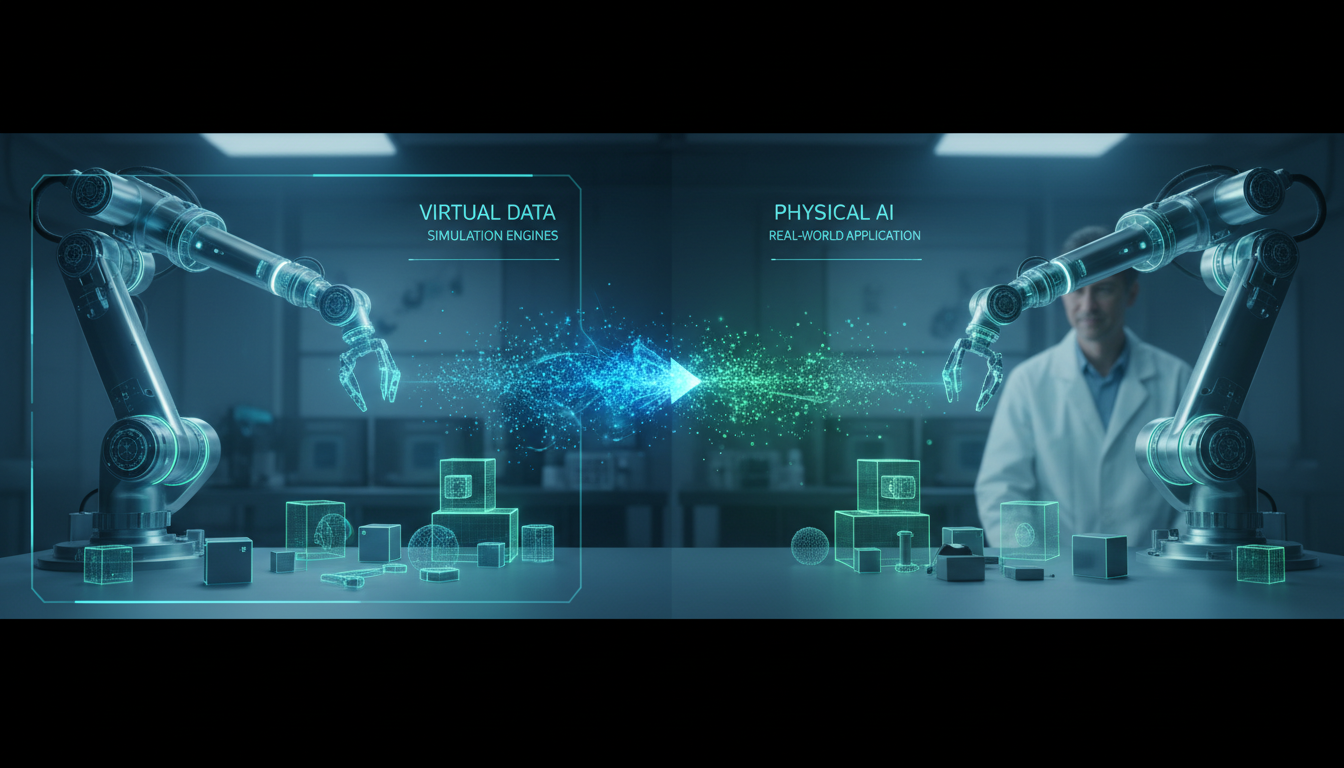
As the landscape of artificial intelligence continues to evolve, a new frontier is emerging that bridges the gap between digital simulations and physical applications. The concept of physical AI, which involves equipping machines with the ability to perform tasks in the real world, is undergoing a transformation thanks to advancements in virtual simulation data. This evolution is being spearheaded by innovative initiatives such as Ai2’s MolmoBot, which leverage synthetic data to revolutionize how AI systems are trained and deployed.
The Traditional Approach to Training Physical AI
Historically, training physical AI systems has been an expensive and labor-intensive process. It requires extensive real-world data collection, often involving teleoperated demonstrations to teach robots how to interact with their environment. For instance, projects like DROID have amassed tens of thousands of trajectories through significant human involvement. Similarly, Google's DeepMind has relied on months of manual data collection to refine its AI models. This model not only inflates research budgets but also limits AI advancements to well-funded organizations.
Enter Virtual Simulation Data
Ai2, through its MolmoBot initiative, is taking a novel approach by using virtual simulation data to train physical AI systems. By creating synthetic environments using tools like the MuJoCo physics engine, Ai2 generates vast datasets of expert manipulation trajectories. This method uses aggressive domain randomization, altering variables such as objects, lighting, and dynamics to create diverse training scenarios. This strategy significantly reduces the reliance on manual data collection and opens the door for smaller organizations to participate in AI development.
Enhancing Efficiency and Cost-Effectiveness
The use of virtual simulation data has revealed notable efficiency improvements. With the capacity to produce over 1,024 episodes per GPU-hour using 100 Nvidia A100 GPUs, the MolmoBot project achieves data throughput nearly four times that of traditional methods. This acceleration not only enhances the return on investment but also shortens the time required for deployment, making physical AI projects more economically feasible.
The Flexibility of MolmoBot
Ai2’s MolmoBot suite provides a range of policy classes that cater to different hardware configurations. For resource-constrained environments, the lightweight MolmoBot-SPOC offers a transformer policy with fewer parameters, while the MolmoBot-Pi0 aligns with existing physical intelligence models. This flexibility allows organizations to integrate physical AI without being tethered to a particular vendor or requiring extensive data collection infrastructure.
Demonstrating Real-World Application
In real-world scenarios, the policies developed through MolmoBot’s virtual simulation data have shown impressive results. During tests, these policies were able to transfer directly to physical tasks involving new objects and environments with no additional fine-tuning required. The primary MolmoBot model, for example, achieved a 79.2 percent success rate in a tabletop pick-and-place task, vastly outperforming models reliant on real-world data.
Open Access and Collaborative Innovation
A key aspect of Ai2's approach is its commitment to open access. By releasing the entire MolmoBot stack, including data and model architectures, Ai2 allows researchers worldwide to audit, adapt, and improve upon their work. This openness is crucial for advancing physical AI, as it encourages collaboration and innovation across the global research community, ensuring that progress is not confined to isolated, proprietary systems.
The Future of Physical AI
The use of virtual simulation data represents a significant shift in how physical AI is developed and deployed. By minimizing reliance on costly and time-consuming real-world data collection, initiatives like Ai2’s MolmoBot are democratizing AI research and enabling broader participation. As more organizations adopt these methods, the capabilities of physical AI are expected to expand, unlocking new possibilities for automation and interaction in diverse fields.
In conclusion, virtual simulation data is not just a tool for training physical AI; it is a catalyst for transforming how these systems are created and integrated into the world. By embracing this approach, the AI community can look forward to a future where physical AI is more accessible, efficient, and impactful than ever before.