Unlocking Efficiency: The Ultimate Guide to AI Agents in Business
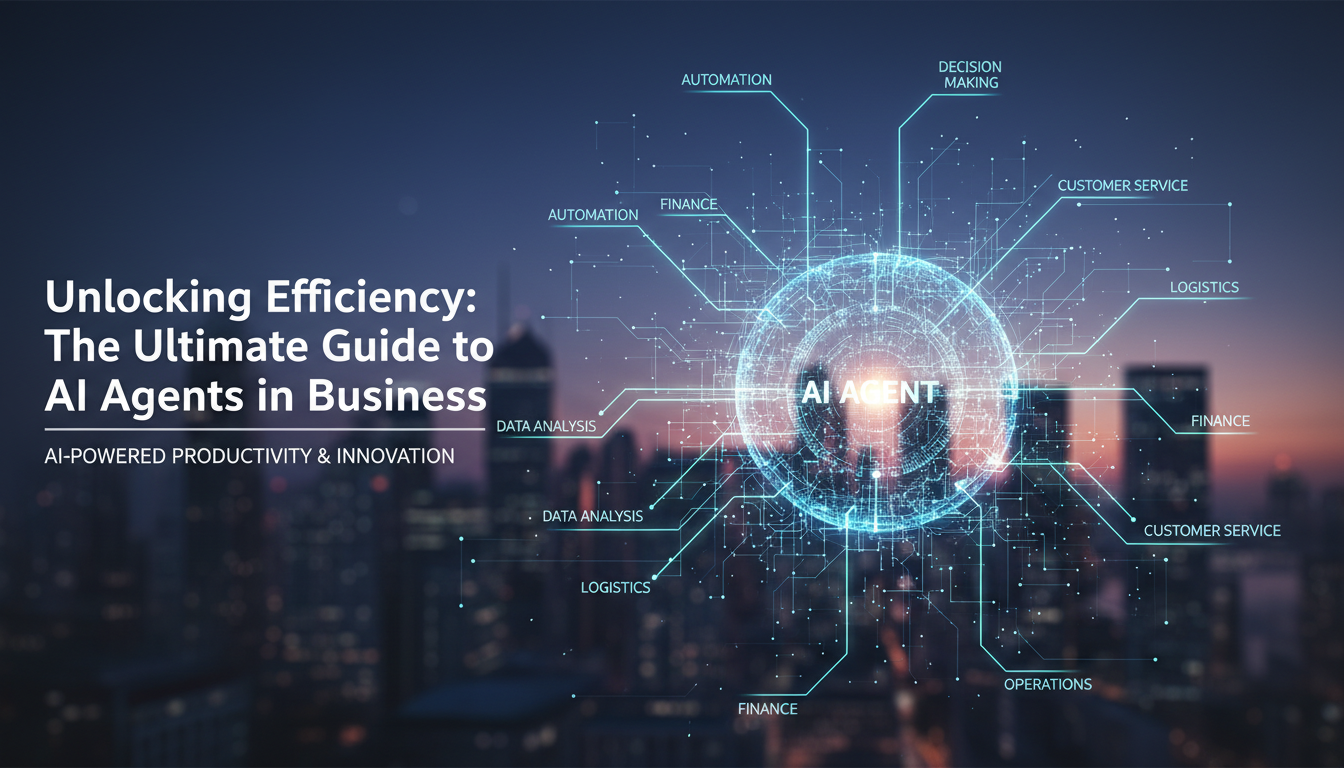
Unlocking Efficiency: The Ultimate Guide to AI Agents in Business
As businesses strive to optimize operations and gain a competitive edge, AI agents have emerged as a vital tool in the corporate toolkit. These intelligent programs, capable of performing tasks autonomously, have revolutionized how enterprises manage workflows and make decisions. This guide delves deep into the world of AI agents, exploring their functionality, benefits, and future potential in the business landscape.
Understanding AI Agents
AI agents are sophisticated systems designed to operate independently, interpreting environmental data, making informed decisions, and executing actions to achieve specific objectives. They are powered by algorithms and machine learning models, which enable them to learn and adapt over time. Key characteristics of AI agents include:
- Autonomy: Operating without constant human oversight.
- Reactivity: Responding promptly to changes in their environment.
- Proactivity: Taking initiative to fulfill their objectives.
- Social ability: Communicating with other agents or human users as needed.
These traits make AI agents versatile tools in various sectors, from customer service to finance.
How Do AI Agents Work?
AI agents simulate human decision-making through advanced algorithms and data processing. Their functionality is built on several core components:
- Data Acquisition: Gathering information through sensors or other data intake mechanisms.
- Processing and Analysis: Interpreting data using machine learning and AI algorithms to draw actionable insights.
- Decision Making: Employing complex logic or predictive models to determine the best actions.
- Action Execution: Implementing decisions, which could range from updating records to operating machinery.
An AI agent's workflow typically follows a structured path: receiving data, analyzing it, deciding on a course of action, and executing the decision. For example, a customer service chatbot processes customer queries using natural language processing, decides on an appropriate response, and replies accordingly.
Benefits of AI Agents in the Enterprise
AI agents bring a multitude of advantages to business operations by automating tasks and offering insights previously out of reach.
Increased Efficiency
AI agents excel at handling repetitive, time-consuming tasks, freeing employees to focus on strategic activities. For instance, chatbots can manage customer inquiries, reducing the burden on human service agents.
Enhanced Decision-Making
By analyzing vast datasets, AI agents uncover trends and patterns that inform strategic decisions. Businesses can leverage AI to forecast sales with greater accuracy, refining inventory management and optimizing resources.
Cost Reduction
Automation through AI reduces labor costs and minimizes errors. Predictive maintenance powered by AI can preempt equipment failures, resulting in significant savings on repairs and downtime.
Scalability
AI agents enable operations to scale efficiently, adapting to changing business needs without proportional increases in human resources.
Competitive Advantage
By adopting AI technologies, enterprises can innovate faster and improve their product offerings or operational processes, staying ahead of the competition.
Types of AI Agents
AI agents can be categorized based on their operational complexity and interaction with their environment:
- Simple Reflex Agents: Respond to current perceptions only, suitable for basic tasks.
- Model-Based Reflex Agents: Use internal models to handle partially observable environments.
- Goal-Based Agents: Perform actions to achieve specific goals, suitable for complex task management.
- Utility-Based Agents: Make decisions to maximize utility, balancing task success with costs.
- Learning Agents: Adapt based on experiences, becoming more proficient over time.
Each type of agent serves different business needs, from straightforward automation to sophisticated decision-making support.
How AI Agents Boost Enterprise Productivity
AI agents enhance productivity by streamlining information retrieval, facilitating collaboration, and offering personalized user experiences. They provide a centralized search interface, reducing the time spent on data searches and minimizing errors. Moreover, they foster knowledge sharing and collaboration across departments, breaking down silos and enhancing communication.
Personalized Experiences
Enterprise platforms employ machine learning to understand user behavior, delivering relevant search results and improving engagement. Customized generative AI experiences enable users to create specific agents and assistants tailored to their business needs, further enhancing productivity.
Conclusion
As AI technology continues to advance, AI agents are set to become even more integral to business operations, offering new possibilities in automation and artificial intelligence. By understanding and leveraging these intelligent tools, enterprises can unlock new levels of efficiency and innovation. Embracing AI agents today positions businesses to thrive in an increasingly competitive and dynamic market.