Unlocking the Power of Vector Databases: A Deep Dive into AI's New Frontier
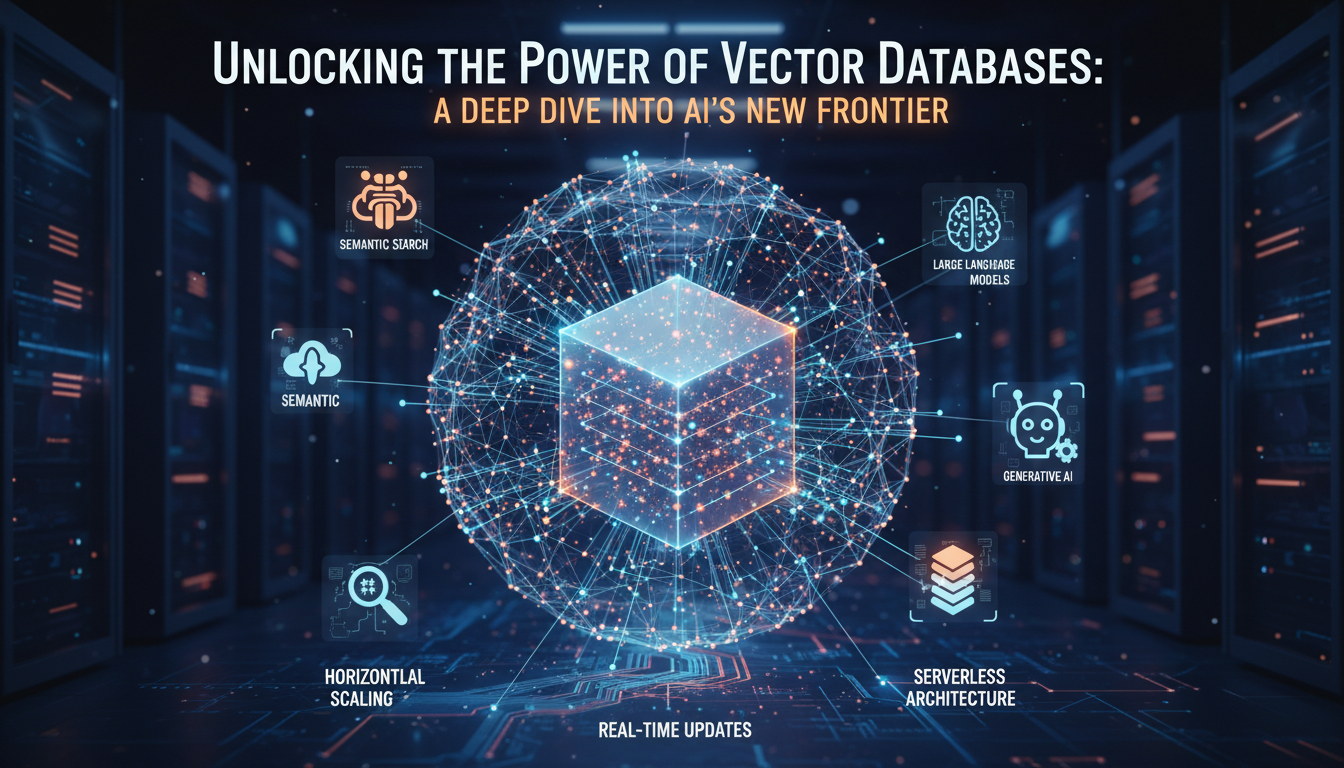
Unlocking the Power of Vector Databases: A Deep Dive into AI's New Frontier
Understanding Vector Databases
In the rapidly evolving landscape of artificial intelligence, vector databases have emerged as a pivotal technology. These specialized databases play a crucial role in indexing and storing vector embeddings, which are integral to AI applications such as large language models, semantic search, and generative AI. Unlike traditional databases that struggle with the complexity and scale of vector data, vector databases are purpose-built to handle these challenges efficiently.
Core Features of Vector Databases
Vector databases, like Pinecone, offer a range of features that make them indispensable for AI applications. They support CRUD operations, metadata filtering, horizontal scaling, and serverless architectures. These capabilities empower developers to manage vector data effectively, ensuring high performance and scalability.
Data Management and Metadata Filtering
One of the key advantages of vector databases is their ability to manage vector data seamlessly. They provide user-friendly features for data insertion, deletion, and updating, making it easier to maintain and query vector embeddings. Additionally, vector databases allow for metadata storage and filtering, enabling finer-grained queries that improve search precision.
Scalability and Real-Time Updates
Vector databases are designed to scale efficiently with growing data volumes and user demands. They support distributed and parallel processing, ensuring optimal performance even as data grows. Unlike standalone vector indices, vector databases handle real-time updates, allowing dynamic changes to keep data fresh without the need for exhaustive re-indexing.
The Role of Serverless Vector Databases
The advent of serverless vector databases marks a significant evolution in the field. These databases separate storage from compute, optimizing costs by using compute resources only when necessary. This architecture addresses critical issues such as multitenancy and data freshness, making serverless vector databases ideal for modern AI applications where cost efficiency and elasticity are paramount.
Geometric Partitioning and Freshness Layer
Serverless vector databases employ sophisticated geometric partitioning algorithms to break down indices into sub-indices. This approach focuses search efforts on specific partitions, reducing compute costs and latency. Additionally, a freshness layer acts as a temporary cache, ensuring that new data is queryable almost immediately, thus solving the freshness problem inherent in traditional systems.
Algorithms and Similarity Measures
Vector databases leverage various algorithms to enable fast and accurate querying. From random projection to product quantization and locality-sensitive hashing, these algorithms transform vector representations to optimize search processes. Moreover, similarity measures such as cosine similarity, Euclidean distance, and dot product play a crucial role in determining the relevance of query results.
Operational Excellence in Vector Databases
Beyond technical capabilities, vector databases excel in operational robustness. They incorporate features like sharding and replication to ensure performance and fault tolerance. Monitoring tools track resource usage, query performance, and system health, enabling proactive management. Furthermore, access control mechanisms protect sensitive data, ensuring compliance with industry regulations.
API and SDK Integration
For developers, the ease of integration is paramount. Vector databases offer intuitive APIs and SDKs that simplify interactions with the database. This user-friendly interface enables developers to focus on building powerful AI solutions without being bogged down by infrastructure complexities.
Conclusion
Vector databases are revolutionizing how we handle vector embeddings in AI applications. By offering specialized features that address the limitations of traditional databases and standalone vector indices, they provide a more effective and streamlined data management experience. As the AI landscape continues to evolve, embracing the power of vector databases will be crucial for unlocking the full potential of AI-driven innovations.