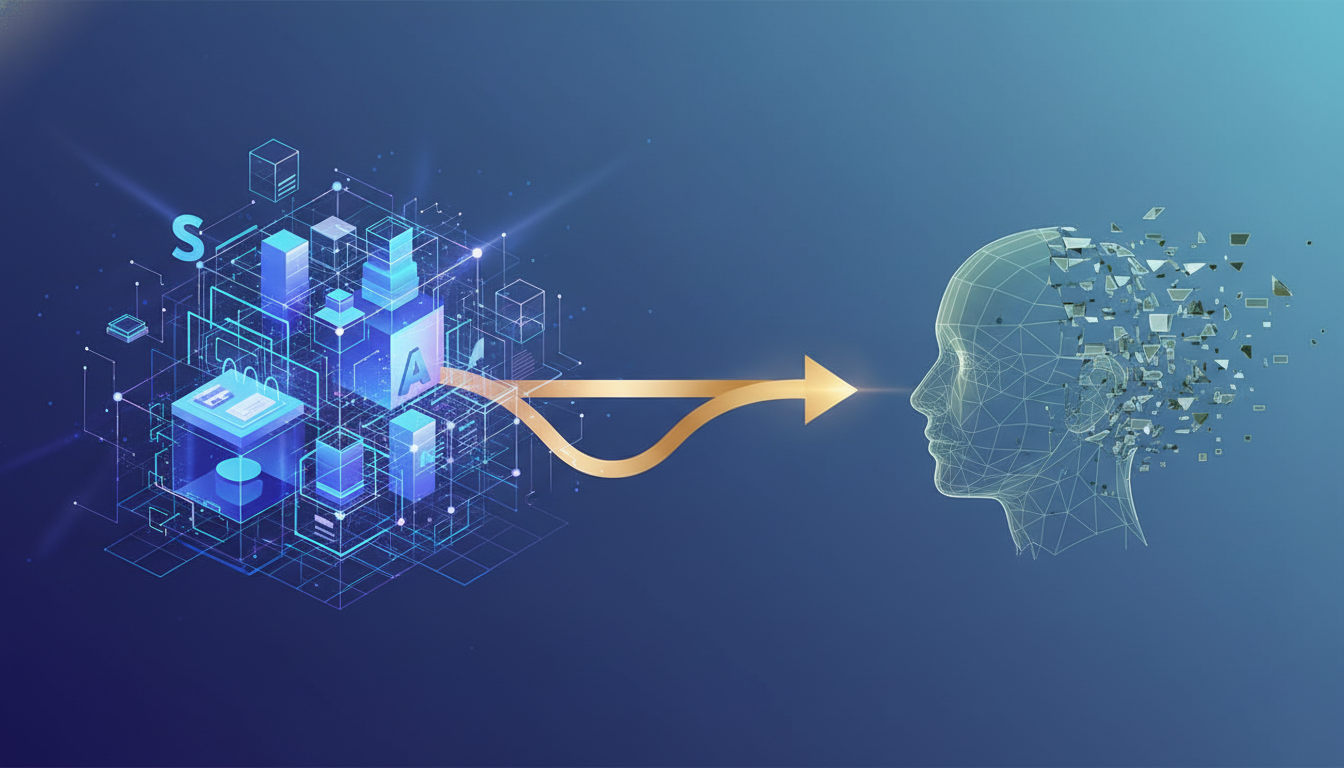
Revolutionizing Enterprise AI: SAP's Bold Bet on Structured Data Over Chatbots
In the ever-evolving landscape of enterprise AI, SAP is setting a new course that could reshape how businesses leverage artificial intelligence. Moving away from the popular trend of large language models (LLMs) and chatbots, SAP is focusing on harnessing the power of structured data to drive business intelligence and decision-making. This strategic pivot, encapsulated in recent acquisitions and investments, highlights a forward-thinking approach to enterprise AI.
The Shift Towards Structured Data
SAP's recent acquisitions of Prior Labs and Dremio underscore a significant shift in its AI strategy. Rather than relying on LLMs, which have primarily been optimized for unstructured internet text, SAP is zeroing in on structured enterprise data. This data includes critical business elements such as invoices, procurement tables, inventories, and transactional databases, which require deterministic outputs and statistical reasoning.
The acquisition of Prior Labs, a German AI startup, is particularly noteworthy. Prior Labs has developed TabPFN, a model specifically designed for tabular enterprise data. This model can perform classification and prediction tasks directly on structured datasets, bypassing the need for retraining for each new task. Such capabilities align perfectly with SAP's vision of leveraging AI for operational tasks like payment delay forecasting and supplier risk analysis.
SAP's Strategic Vision
At the heart of SAP's strategy is a conviction that the greatest untapped opportunity in enterprise AI lies in structured data management. CTO Philipp Herzig emphasized this point, arguing that the focus should be on AI systems built to reason over structured business data rather than on conversational fluency. This belief is driving SAP to invest over €1 billion to establish a frontier AI research lab dedicated to business applications.
SAP's approach involves developing specialized foundation models optimized for enterprise resource planning (ERP) systems. By doing so, SAP aims to enhance the efficiency of processes such as financial record management, supply chain systems, and procurement workflows. This shift suggests a broader move in enterprise AI architecture towards systems that prioritize structured data reasoning over traditional LLM functionalities.
Building a New Enterprise AI Stack
SAP's acquisitions are not just about enhancing capabilities—they are about redefining the architecture of enterprise AI systems. Today's enterprise AI systems often rely on external LLM APIs and copilots. In contrast, SAP is building a stack that separates data infrastructure, predictive modeling, orchestration, and conversational interfaces into distinct layers.
Dremio plays a crucial role in this new stack by addressing the data layer. Its platform unifies fragmented enterprise datasets across cloud environments and legacy systems, strengthening SAP's Business Data Cloud platform. Prior Labs, on the other hand, focuses on predictive modeling over enterprise datasets, offering statistical prediction capabilities directly on tabular data.
SAP's Joule assistant functions as the orchestration layer, facilitating "agentic AI" workflows. These workflows are designed to retrieve enterprise information, automate processes, and execute tasks across SAP systems, offering decision intelligence like never before.
The Competitive Edge
SAP's strategy is also a response to the competitive landscape in enterprise software. As AI assistants become more capable, the interface layer increasingly shifts towards external AI systems. This shift poses a strategic challenge for ERP vendors like SAP, which risk becoming mere infrastructure providers rather than the central intelligence layer within organizations.
By focusing on structured-data intelligence, SAP is positioning itself to maintain control over the reasoning layer that underpins enterprise workflows. This approach differentiates SAP from competitors like Microsoft, Salesforce, and Oracle, which are integrating generative AI capabilities across their applications.
Conclusion
SAP's bold bet on structured data over chatbots marks a pivotal moment in the evolution of enterprise AI. By prioritizing systems that can reason over business data, SAP is not only enhancing its own capabilities but also setting a new standard for the industry. This strategic direction points to a future where specialized foundation models, workflow-native systems, and enterprise data orchestration take precedence over conversational interfaces. As SAP continues to innovate, the next competition in enterprise software may well center on who controls the data, reasoning, and execution layers, rather than simply the interface.
Saksham Gupta
Founder & CEOSaksham Gupta is the Co-Founder and Technology lead at Edubild. With extensive experience in enterprise AI, LLM systems, and B2B integration, he writes about the practical side of building AI products that work in production. Connect with him on LinkedIn for more insights on AI engineering and enterprise technology.