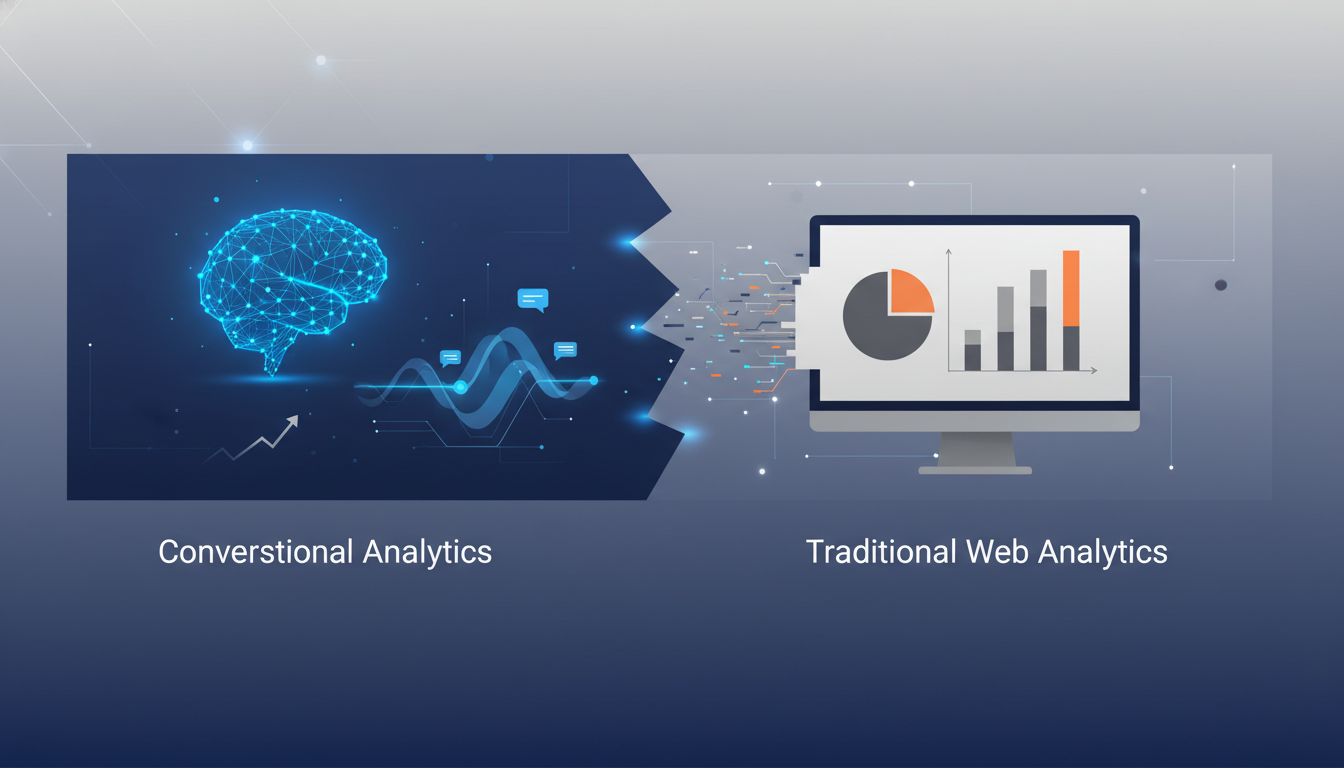
Unlocking the Future: Conversational Analytics vs. Traditional Web Analytics for Enterprise Leaders
Introduction
In the fast-evolving digital landscape, enterprise leaders are faced with an abundance of customer data. The real challenge lies not in collecting this data but in deciphering customer intent in real time. For nearly two decades, traditional web analytics platforms have been the backbone of measuring digital performance through metrics like page views, bounce rates, and conversion funnels. While these metrics remain crucial, they often fall short in explaining the motivations behind customer behaviors.
Enter conversational analytics—a transformative approach reshaping enterprise intelligence strategies. Unlike traditional analytics that focuses on passive behavioral measurement, conversational analytics emphasizes active intent understanding, powered by AI and natural language processing (NLP).
As customer interactions increasingly occur through chatbots, voice assistants, and messaging platforms, businesses need analytics systems capable of interpreting sentiment, intent, and decision patterns—not just clicks. This blog explores the strategic differences between conversational analytics and traditional web analytics and how they are driving the evolution of enterprise intelligence.
The Evolution of Enterprise Analytics
Traditional analytics systems were crafted for a web-first era, focusing on page navigation patterns, clickstream analysis, and conversion funnels. However, the landscape has dramatically shifted. Modern customer experiences are conversational, spanning AI chat assistants, voice interfaces, and intelligent search experiences. Consequently, enterprises now generate vast amounts of unstructured conversational data, which traditional analytics platforms struggle to interpret.
According to industry experts, enterprises that implement AI-powered customer engagement systems witness significant improvements in customer satisfaction and operational efficiency. This shift fundamentally changes analytics priorities, moving from simple behavioral tracking to understanding customer intent and emotions.
What Is Traditional Web Analytics?
Traditional web analytics involves tracking and analyzing user interactions across websites and digital applications. Platforms like Google Analytics and Adobe Analytics focus on structured behavioral metrics, such as sessions, bounce rates, and conversion rates. These systems are essential for marketing attribution, campaign optimization, and e-commerce analytics. However, they primarily measure observable behavior, lacking the depth needed to interpret customer intent and sentiment.
What Is Conversational Analytics?
Conversational analytics analyzes customer interactions across voice, chat, and messaging platforms. It leverages technologies like NLP, sentiment analysis, and machine learning to extract meaning from natural language interactions. The goal is to understand human intent, context, emotion, and outcomes, rather than just measuring engagement.
Conversational analytics provides insights into intent recognition, sentiment scores, and conversational friction, enabling enterprises to uncover insights hidden within unstructured interactions. This approach is crucial as customers increasingly expect real-time assistance and personalized interactions.
11 Critical Differences: Conversational Analytics vs. Traditional Web Analytics
- Behavioral Data vs. Intent Data: Traditional analytics measures behavior; conversational analytics explains intent.
- Structured Data vs. Unstructured Data: Traditional relies on structured data; conversational handles unstructured language data.
- Funnel Tracking vs. Journey Understanding: Traditional focuses on funnels; conversational on contextual journeys.
- Historical Reporting vs. Real-Time Intelligence: Traditional prioritizes historical data; conversational supports real-time insights.
- Quantitative Metrics vs. Qualitative Insights: Traditional provides quantitative data; conversational offers qualitative understanding.
- Clickstream Visibility vs. Emotional Intelligence: Traditional lacks emotional context; conversational captures emotional indicators.
- Campaign Optimization vs. Interaction Optimization: Traditional aids marketing; conversational enhances interaction quality.
- Static Dashboards vs. Adaptive AI Systems: Traditional dashboards are static; conversational systems are AI-driven and adaptive.
- Channel-Centric Analytics vs. Omnichannel Intelligence: Traditional is often website-focused; conversational spans multiple channels.
- Human Interpretation vs. AI-Assisted Intelligence: Traditional requires manual interpretation; conversational uses AI for insight discovery.
- Digital Optimization vs. Enterprise Intelligence: Traditional optimizes digital assets; conversational builds enterprise-wide intelligence.
Enterprise Use Cases for Conversational Analytics
Conversational analytics is pivotal in optimizing customer support, monitoring AI copilot performance, enhancing voice of customer programs, and driving sales and revenue intelligence. For example, in customer support, it identifies recurring complaints and unresolved intents, enabling more intelligent operations. In sales, it detects buying signals and churn indicators, facilitating proactive engagement strategies.
Why the Future Is Hybrid Analytics
The future lies in hybrid intelligence, combining traditional and conversational analytics into unified ecosystems. While traditional analytics remains essential for traffic measurement and campaign analysis, conversational analytics enhances customer understanding and AI-driven engagement. Together, they form a comprehensive framework for customer intelligence, crucial for enterprises aiming to stay competitive in 2026 and beyond.
Conclusion
The evolution from traditional web analytics to conversational analytics marks a significant shift in enterprise intelligence. Organizations integrating these approaches gain deeper customer insights, stronger personalization capabilities, and more adaptive AI-driven strategies. The future of enterprise analytics is not just about measuring clicks; it's about understanding conversations. For enterprises modernizing their analytics ecosystems, leveraging both traditional and conversational analytics is key to unlocking the full potential of customer data.
Saksham Gupta
Founder & CEOSaksham Gupta is the Co-Founder and Technology lead at Edubild. With extensive experience in enterprise AI, LLM systems, and B2B integration, he writes about the practical side of building AI products that work in production. Connect with him on LinkedIn for more insights on AI engineering and enterprise technology.