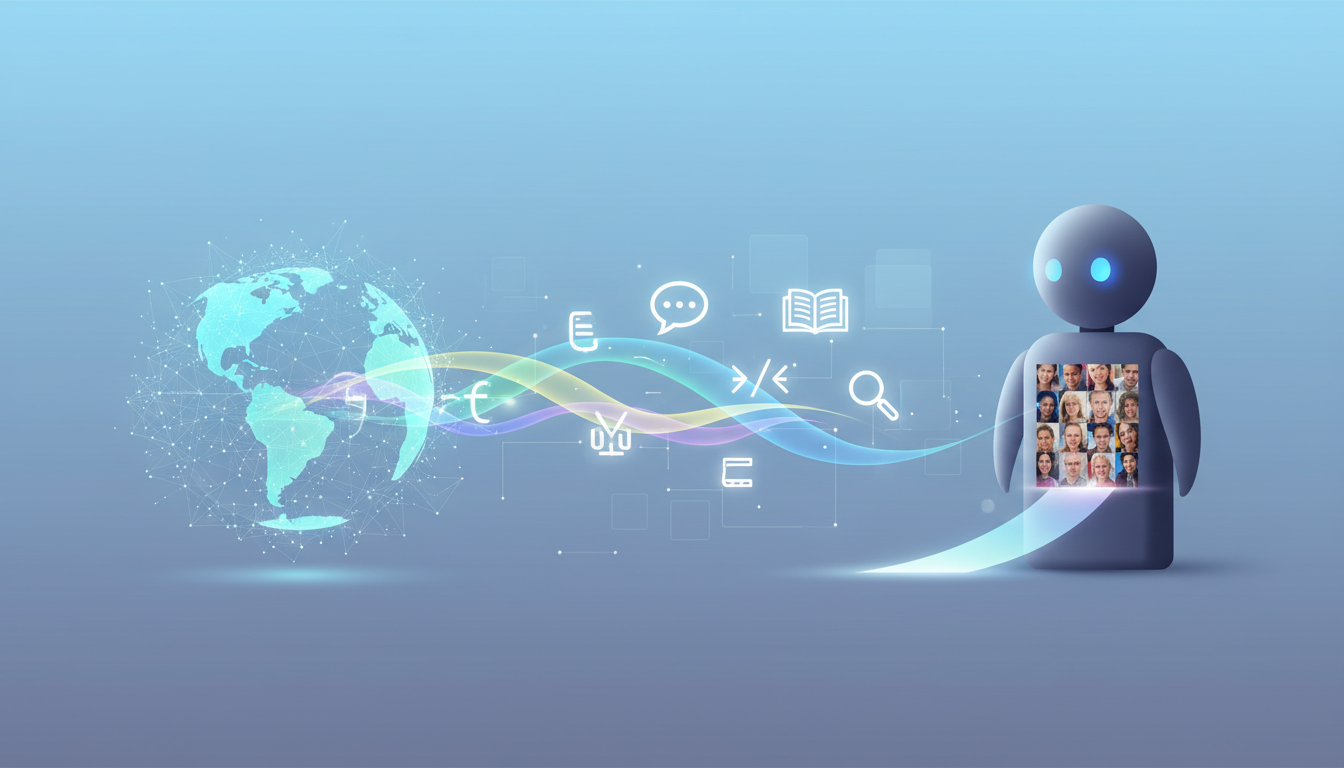
Bridging the Language Gap: Making AI Accessible for All
In today's digital age, artificial intelligence (AI) has emerged as a crucial tool for accessing information and solving everyday problems. Whether it's a farmer seeking advice on crop diseases or a student looking for educational resources, AI systems are increasingly becoming the go-to solution. However, the effectiveness of AI largely depends on its ability to understand and communicate in the user's language. This poses a significant challenge as the majority of AI models are predominantly trained on data in a limited number of languages, leaving many people unable to fully access the benefits of AI.
The Language Barrier in AI
The dominance of English and a few other languages in online content has led to an uneven distribution of AI benefits. According to recent reports, English accounts for about half of all online content, significantly influencing how AI systems learn and respond. As a result, individuals who speak less commonly represented languages face barriers in accessing AI-driven solutions. This disparity is evident in the usage rates of AI tools, which are significantly lower in regions where local languages have minimal digital presence.
Expanding AI to Serve Diverse Linguistic Communities
Recognizing the importance of linguistic inclusivity, researchers and data scientists are working towards expanding AI's language support. Microsoft, for instance, is leading initiatives to build open tools and partnerships that make AI more accessible in diverse linguistic contexts. The goal is to ensure that AI systems are not just technically proficient but also culturally and linguistically relevant.
Project Gecko: Community-Centric AI Development
One of the notable projects aimed at bridging the language gap is Project Gecko. This initiative prioritizes the integration of local languages and contexts in AI development from the onset. By focusing on regions like East Africa and South Asia, Project Gecko aims to provide practical guidance tailored to the specific needs of these communities. The project emphasizes the importance of designing AI systems that are attuned to the cultural and linguistic nuances of the areas they serve.
MMCTAgent: Beyond Textual Data
While much of AI's current capabilities are based on text, significant information is embedded in images, videos, and audio. MMCTAgent is an AI tool designed to navigate these non-textual data sources effectively. It breaks down questions into manageable steps, allowing it to search and synthesize information from various media formats. This capability is particularly beneficial in applications like FarmerChat, where guidance is derived from local farming videos, ensuring relevance and accuracy.
Paza: Enhancing Speech Recognition
Speech recognition technology offers a convenient way for users to interact with AI systems. However, it often struggles with languages lacking substantial training data or when accents deviate from those the system was initially trained on. The Paza project addresses these challenges by developing speech models for underrepresented languages and creating benchmarks like PazaBench to measure and improve performance across different languages and accents.
LINGUA: Building Open Language Datasets
For AI to be effective in more languages, access to comprehensive datasets is essential. The LINGUA project by Microsoft's AI for Good Lab focuses on creating and sharing new datasets for underrepresented languages. By providing resources for languages with limited digital presence, LINGUA supports the development of AI models that can operate in a broader range of linguistic contexts.
Bring Your Own Language: A Framework for Inclusion
The Bring Your Own Language (BYOL) framework offers a systematic approach to incorporating more languages into AI systems. By assessing the availability of digital material for a language and categorizing it into tiers, BYOL provides a scalable method for expanding AI language capabilities. This framework allows for the adaptation of AI tools to meet the unique needs of different linguistic communities.
Conclusion
As AI continues to integrate into everyday life, addressing the language gap is not just a technical challenge but a moral imperative. Ensuring that AI systems are inclusive and accessible across languages and cultures is essential for empowering communities worldwide. By investing in projects that prioritize linguistic diversity, we can make AI a truly global resource, accessible and beneficial to all.
Saksham Gupta
Founder & CEOSaksham Gupta is the Co-Founder and Technology lead at Edubild. With extensive experience in enterprise AI, LLM systems, and B2B integration, he writes about the practical side of building AI products that work in production. Connect with him on LinkedIn for more insights on AI engineering and enterprise technology.