Demystifying Quantum Computing: 10 Essential Terms You Need to Know
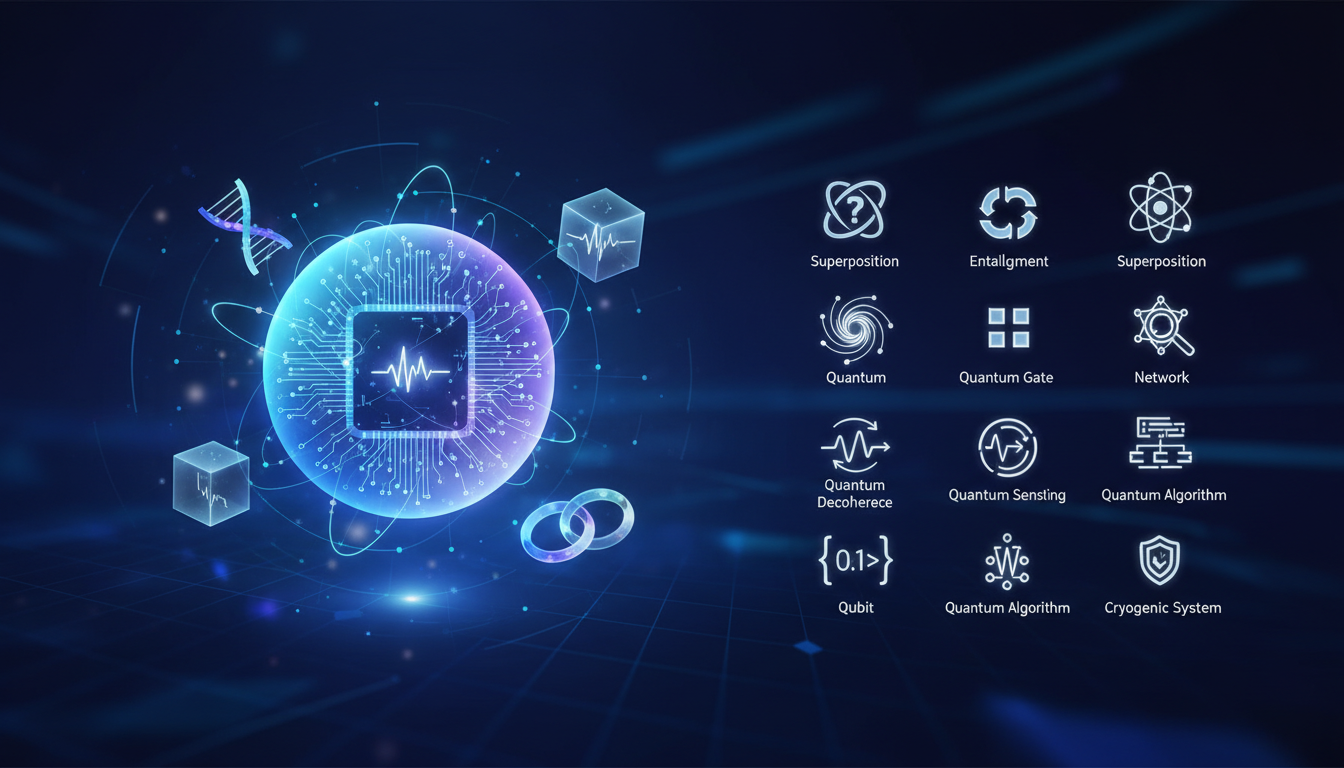
Quantum computing has captured imaginations for decades, often regarded as a groundbreaking technology perpetually on the horizon. However, recent advancements suggest that quantum computing is transitioning from theoretical promise to practical reality. Researchers are starting to talk in terms of years, not decades, heralding a new era where this technology might soon impact sectors ranging from materials science to pharmaceuticals. But with this evolution comes a need to understand its complex terminology. Here's a breakdown of ten essential terms that form the foundation of quantum computing.
Quantum: Beyond the Individual
At the heart of quantum computing is the concept of quantum behavior, which refers to the smallest scales of nature. Unlike classical systems that operate independently, quantum systems function as a cohesive whole, with components interacting in complex ways. This interconnectedness is what allows quantum computers to solve problems in novel ways, harnessing these interactions to perform computations that classical computers would find impossible.
Qubits: The Building Blocks
Qubits are the fundamental units of information in a quantum computer, akin to bits in classical computing. Unlike bits, which exist in a state of 0 or 1, qubits can exist in multiple states simultaneously, thanks to a property known as superposition. This capability enables quantum computers to process vast amounts of information concurrently, paving the way for solving complex problems much faster than classical computers.
Superposition: Embracing Multiple Possibilities
Superposition is a unique property that allows qubits to explore numerous possibilities at once. This means that, rather than following a single path to a solution, a quantum computer can investigate multiple potential solutions simultaneously. This characteristic is crucial for tasks that involve searching large datasets or solving complex equations, providing an edge over traditional computing methods.
Interference: Shaping Outcomes
Interference in quantum computing refers to the phenomenon where various computational paths combine, either reinforcing or canceling each other out. This allows quantum computers to emphasize the most promising solutions while minimizing less likely outcomes. By controlling interference, quantum systems can efficiently zero in on the most accurate results, vastly improving problem-solving capabilities.
Entanglement: The Power of Relationships
Entanglement is a phenomenon where qubits become interconnected in such a way that the state of one qubit directly affects the state of another, regardless of distance. This interdependence allows quantum computers to process complex computations more efficiently than classical computers, which handle information in isolation. Entanglement is key to unlocking the full potential of quantum computing, enabling it to solve problems involving intricate relationships and dependencies.
Gates: Directing Quantum Operations
Just like classical computing uses logic gates to process information, quantum computing employs quantum gates to manipulate qubit states. These gates control the interactions between qubits, enabling them to perform complex calculations. The ability to program and control these gates is crucial for developing quantum algorithms that can tackle real-world challenges.
Error Correction: Maintaining Accuracy
Quantum systems are notoriously sensitive to environmental disturbances, leading to potential errors in computations. To mitigate this, quantum error correction techniques are employed. These methods involve spreading information across multiple qubits, ensuring that errors in individual qubits do not derail the overall computation. Effective error correction is vital for the practical application of quantum computing, ensuring reliable and accurate results.
Fault Tolerance: Ensuring Reliability
Fault tolerance is the ability of a quantum computer to continue functioning accurately even in the presence of errors. Achieving fault tolerance means that the system can detect and correct errors quickly enough to prevent them from affecting the final outcome. This capability is essential for running long and complex computations, such as simulating chemical reactions or exploring new materials.
Logical Qubits: Achieving Stability
Logical qubits represent a significant milestone in quantum computing, as they are qubits that can perform computations while maintaining stability throughout the process. This stability is achieved through effective error correction and fault tolerance techniques, allowing quantum computers to perform meaningful calculations without succumbing to errors.
Topological Qubits: Stability by Design
Topological qubits are an innovative approach to enhancing the stability of quantum systems. By leveraging the principles of topology, these qubits are designed to be inherently stable, reducing the reliance on error correction methods. This design aims to create quantum computers that are more robust and resilient, capable of tackling the most complex computational challenges.
As quantum computing continues to advance, understanding these foundational terms will be crucial for grasping the potential impact of this transformative technology. Whether it's simulating molecular behavior or optimizing complex systems, quantum computing promises to revolutionize how we approach and solve problems.
Saksham Gupta
Founder & CEOSaksham Gupta is the Co-Founder and Technology lead at Edubild. With extensive experience in enterprise AI, LLM systems, and B2B integration, he writes about the practical side of building AI products that work in production. Connect with him on LinkedIn for more insights on AI engineering and enterprise technology.