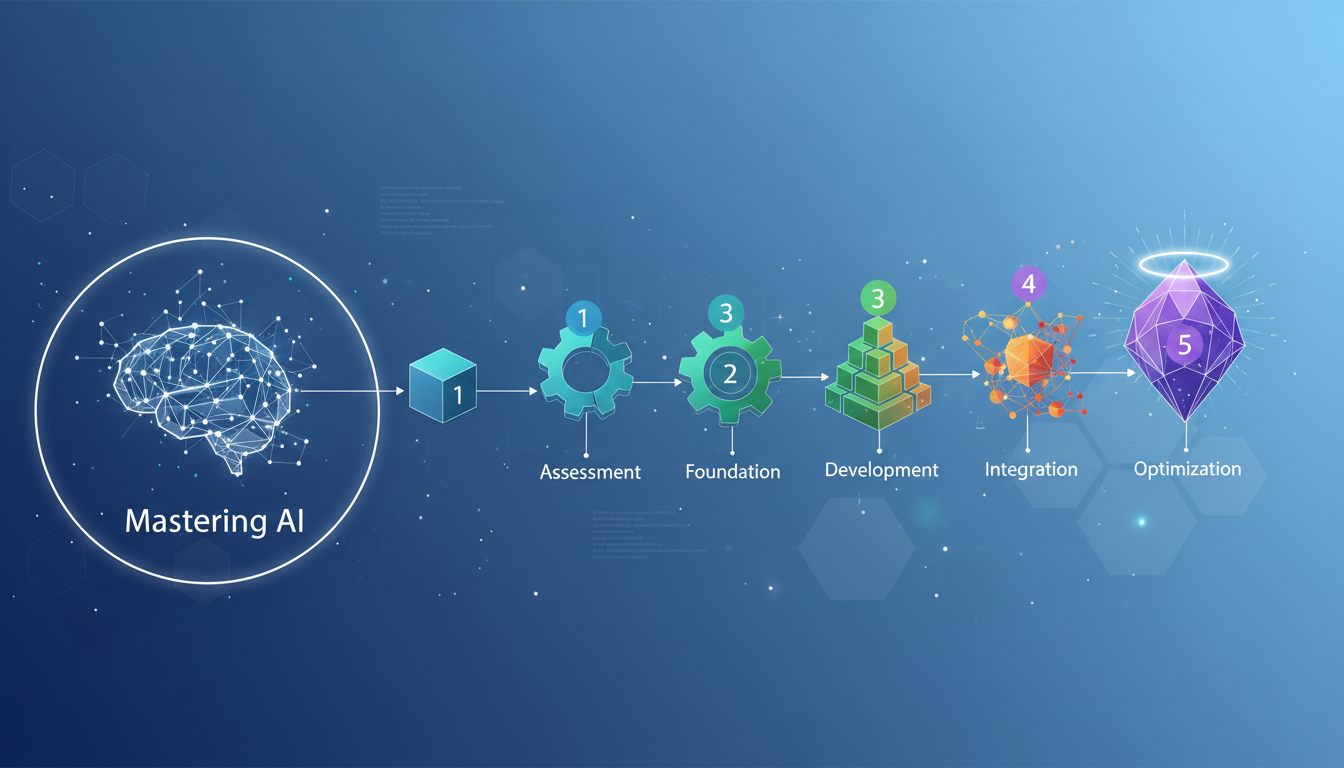
Mastering AI: The 5 Essential Stages of Readiness for Every Enterprise
In today’s rapidly evolving business landscape, Artificial Intelligence (AI) has transitioned from being a competitive edge to a fundamental requirement for enterprise success. Yet, many organizations struggle to move beyond fragmented AI experiments to achieve meaningful, scalable outcomes. This is where the AI readiness maturity model becomes a crucial tool.
Understanding the AI Readiness Maturity Model
The AI readiness maturity model serves as a roadmap for enterprises to assess their current AI capabilities and strategically plan for future growth. This model is not merely about having AI technologies in place; it’s about ensuring these technologies can be scaled, governed, and aligned with the broader business strategy. According to Gartner, a substantial percentage of AI projects fail to advance beyond the pilot stage due to inadequate data readiness and governance frameworks.
The Five Stages of AI Readiness Maturity
Stage 1: Awareness and Foundation
At the foundational stage, organizations are just beginning to recognize AI's potential. Efforts are often isolated and lack strategic focus. Key characteristics of this stage include:
- Initial exploration without a structured plan
- Limited alignment with executive leadership
- Absence of governance and ethical guidelines
To advance, organizations need to establish a solid data foundation and clearly define how AI initiatives align with their business objectives.
Stage 2: Pilots and Capability Building
In this stage, organizations start experimenting with AI through targeted pilot projects. They begin to:
- Deploy AI in specific departments like marketing or operations
- Upskill and hire AI talent
- Develop initial governance frameworks
However, the risk here is fragmentation. Without centralized coordination, AI initiatives can become siloed, making it difficult to scale.
Stage 3: Operationalization
Operationalization is a critical turning point where AI is integrated into core business processes. Characteristics of this stage include:
- Embedding AI models into daily operations
- Establishing Machine Learning Operations (MLOps) pipelines
- Standardizing data platforms
Success in this stage hinges on scalability and reliability, turning AI from an experiment into a core business function.
Stage 4: Enterprise-Scale Adoption
At this stage, AI influences decisions across the entire organization. The focus shifts to optimization and value realization:
- AI-driven decision-making becomes commonplace
- Strong alignment between business and technology teams
- Continuous monitoring of AI performance and outcomes
Organizations that reach this stage are not just using AI—they are leveraging it to compete and differentiate themselves in the market.
Stage 5: AI-Driven Enterprise (Agentic Stage)
The final stage represents the pinnacle of AI maturity. Enterprises evolve into AI-driven entities where intelligent systems autonomously optimize processes:
- Deployment of autonomous AI agents
- End-to-end workflow automation
- Real-time data-driven decision-making
In this stage, AI becomes a strategic differentiator, and organizations redefine their business models around AI capabilities.
Mapping Your Enterprise to the AI Maturity Curve
To effectively use the AI readiness maturity model, enterprises must assess their current position across various dimensions such as data readiness, technology infrastructure, governance, talent, and business alignment.
Conducting an Assessment
- Score each dimension: Evaluate data quality, technology platforms, governance, talent, and business alignment.
- Identify bottlenecks: Common limitations include data quality and governance structure.
- Prioritize transformation areas: Focus on closing high-impact gaps.
Building an Enterprise AI Roadmap
The AI readiness maturity model provides a framework that must be translated into an actionable roadmap:
- Phase 1: Establish foundations by aligning AI vision with business outcomes and setting up governance frameworks.
- Phase 2: Pilot high-value use cases to measure ROI and feasibility.
- Phase 3: Build scalable infrastructures such as unified data platforms and MLOps pipelines.
- Phase 4: Scale AI across the enterprise with standardized workflows and cross-functional collaboration.
- Phase 5: Drive continuous innovation by evolving AI capabilities and optimizing human-AI collaboration.
Conclusion: From AI Readiness to AI Leadership
The journey from AI readiness to becoming an AI leader requires more than just adopting new technologies. It involves aligning AI with business strategy, building a robust data foundation, embedding governance and ethics, and scaling operations systematically. As AI technologies continue to evolve, enterprises must embrace this structured transformation to unlock exponential value and avoid being left behind in an increasingly AI-driven world.
Saksham Gupta
Founder & CEOSaksham Gupta is the Co-Founder and Technology lead at Edubild. With extensive experience in enterprise AI, LLM systems, and B2B integration, he writes about the practical side of building AI products that work in production. Connect with him on LinkedIn for more insights on AI engineering and enterprise technology.