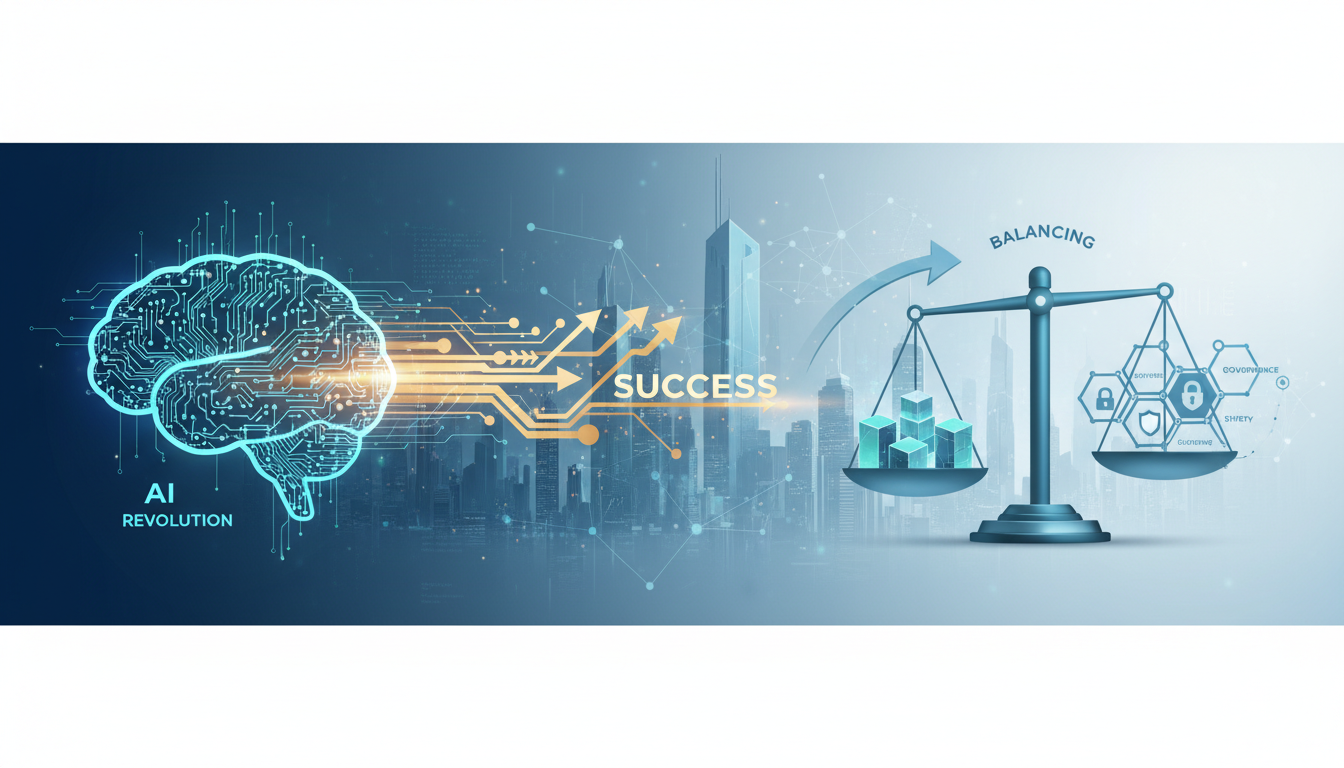
Navigating the AI Revolution: Balancing Success with Governance in Software Development
The advent of artificial intelligence (AI) in software development has been transformative, ushering in a new era of innovation and efficiency. However, as enterprises rush to harness AI's potential, they face the critical challenge of integrating these technologies safely and effectively. A recent report by OutSystems, The State of AI Development 2026, highlights this duality: the promise of AI's capabilities versus the necessity for robust governance frameworks. As AI transitions from pilot projects to production phases, understanding how to balance these forces becomes paramount.
The State of AI Adoption in Software Development
AI's integration into software development is increasingly prevalent, with many enterprises moving beyond the experimental phase. According to the OutSystems survey, which involved 1,879 IT leaders, a significant portion of companies are adopting agentic strategies. An impressive 97% of respondents are exploring AI-driven initiatives, with nearly half describing their capabilities as "advanced" or "expert." Notably, Indian companies lead in successful AI implementations, with 50% reporting their projects as over half successful.
Despite these advancements, the report underscores a gap between AI adoption and governance. IT leaders are eager to deploy AI agents, but many organizations lack the necessary controls to manage these technologies safely. This discrepancy highlights a pressing need for developing comprehensive governance structures that can keep pace with AI's rapid deployment.
The Importance of Governance in AI Deployment
Governance in AI deployment extends beyond simple oversight; it involves creating a framework that ensures reliability and accountability. The OutSystems report reveals that only 36% of respondents have centralized AI governance, while the remaining 64% either lack it or rely on project-specific rules. This fragmented approach can lead to inconsistencies and potential security risks.
The integration of AI into software development necessitates a robust governance model that encompasses orchestration, auditability, and human-in-the-loop checkpoints. These elements are crucial for maintaining control over AI systems, especially in regulated or mission-critical environments. As AI becomes more autonomous, organizations must ensure that their oversight mechanisms are as advanced as the technologies they aim to control.
The Role of Integration and Legacy Systems
A critical barrier to AI advancement identified in the report is the integration with existing legacy systems. Nearly half of the survey respondents cited legacy integration as the most significant challenge in scaling AI projects. The complexity of merging new AI technologies with established platforms often leads to stalling between pilot and production phases.
Organizations must prioritize seamless integration to prevent AI deployment from being hindered by outdated infrastructure. While data clean-up campaigns are often advocated, the report suggests that AI systems can thrive in complex data environments if governance and integration efforts are simultaneously enhanced. Thus, businesses should focus on strengthening these areas to facilitate smoother AI transitions.
AI's Impact on Software Development and IT Functions
AI's most tangible benefits are currently realized within IT functions, particularly in software development and operations. The OutSystems survey indicates that AI is predominantly used for IT operations (55%) and data analysis (52%), followed by workflow automation and customer experience enhancements. These internal applications highlight AI's potential to enhance productivity and efficiency behind the scenes.
Interestingly, while the expectation is that AI will primarily drive cost reduction and efficiency gains, only 22% of respondents found these areas to be the most effective. Instead, AI's strength lies in augmenting software developers' capabilities through generative AI tools. This finding suggests that AI's initial value proposition is more about enhancing existing processes rather than replacing them entirely.
Building Trust and Managing AI Sprawl
Trust in AI systems is gradually improving, with 73% of respondents expressing moderate to high trust in autonomous AI agents. However, trust in third-party AI-generated code remains slightly lower. Despite this progress, the report notes concerns about "AI sprawl," referring to the uncoordinated proliferation of AI systems within enterprises.
To address this, organizations should consider implementing centralized management platforms to oversee AI deployments. Such systems can help mitigate the risks associated with disparate AI applications and ensure consistent governance across the enterprise. As AI continues to evolve, maintaining control over its growth and application will be crucial for sustainable success.
Conclusion
The integration of AI into software development is a double-edged sword, offering immense potential alongside significant governance challenges. As organizations navigate this landscape, they must prioritize developing robust governance frameworks that can keep pace with AI's rapid evolution. By focusing on integration, trust-building, and centralized management, enterprises can unlock AI's full potential while safeguarding against its inherent risks. As the AI revolution unfolds, balancing innovation with governance will be the key to long-term success in software development.
Saksham Gupta
Founder & CEOSaksham Gupta is the Co-Founder and Technology lead at Edubild. With extensive experience in enterprise AI, LLM systems, and B2B integration, he writes about the practical side of building AI products that work in production. Connect with him on LinkedIn for more insights on AI engineering and enterprise technology.