Revolutionizing RAG: How Pinecone Nexus Transforms Enterprise AI Efficiency
The concept of retrieval-augmented generation (RAG) has been both a boon and a bane for enterprises. By connecting large language models (LLMs) to proprietary knowledge bases, businesses have been able to leverage AI in unprecedented ways. However, the rising costs of inference, fragile retrieval pipelines, and persistent hallucinations have made the implementation of RAG a daunting task, often leading to hefty financial penalties and abandoned projects.
The Advent of Pinecone Nexus
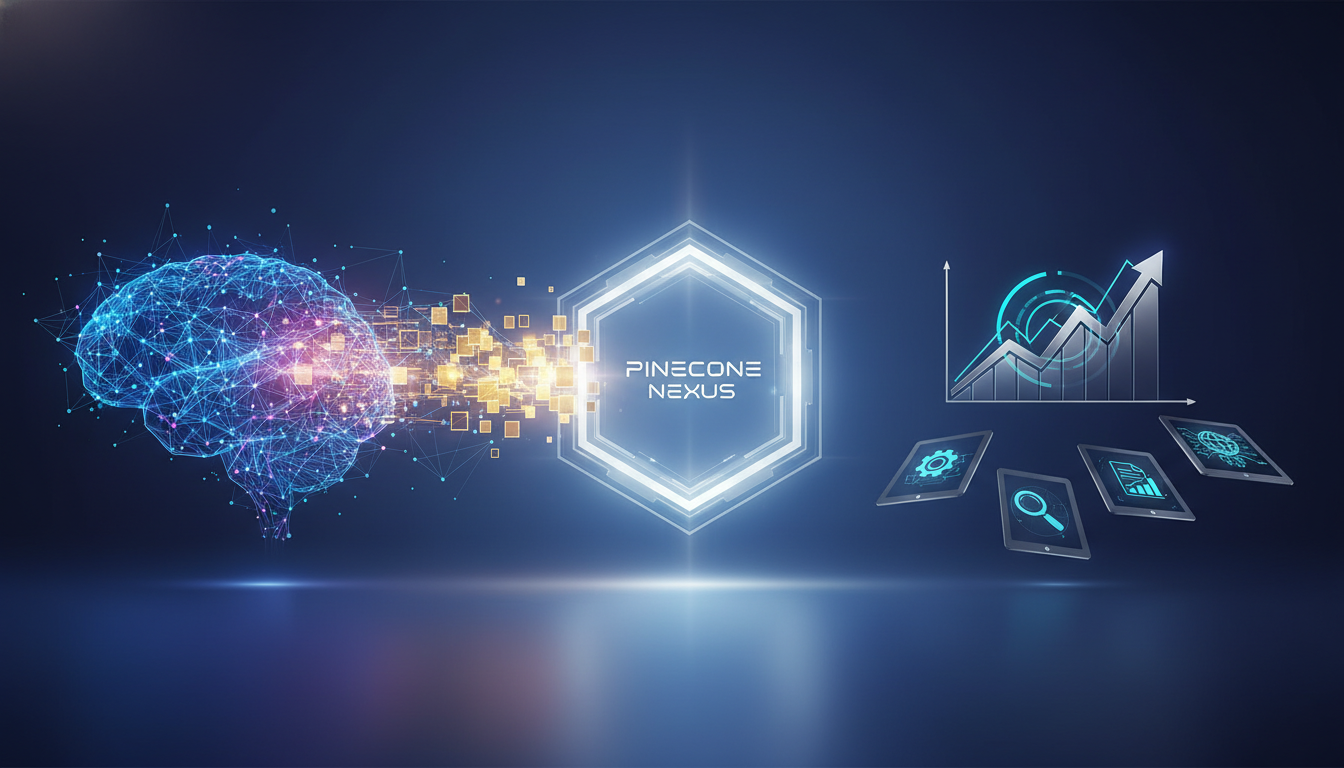
Enter Pinecone Nexus, a groundbreaking innovation from the vector database company Pinecone. Designed to address the inherent complexities of agentic RAG workflows, Nexus offers a compilation knowledge layer that promises to transform the way enterprises handle AI tasks. Unlike traditional RAG systems that rely on a simplistic retrieval process, Pinecone Nexus constructs a dynamic knowledge graph that integrates structured metadata, vector embeddings, and relational context. This allows for a more sophisticated query response process, as demonstrated in a live demo where a complex financial research query was resolved in record time with fully attributed, cross-referenced results.
A Compilation Layer, Not Just Retrieval
One of the standout features of Nexus is its "compile-then-retrieve" paradigm. Traditional RAG pipelines conduct a stateless similarity search, which can falter when a query requires reasoning across multiple data points. Nexus, on the other hand, constructs a living knowledge graph that updates incrementally. This graph captures entities, relationships, cross-references, and temporal versions, creating a user-specific knowledge view that facilitates accurate reasoning.
Seamless Integration with Agent Frameworks
Pinecone Nexus is designed for deep integration with agent orchestration tools. It offers a GraphQL API and native SDKs that allow developers to incorporate Nexus into their existing pipelines without extensive rewrites. During its launch, partners from LangChain and Arize AI demonstrated how a Nexus-backed agent could significantly reduce token consumption by automatically pruning irrelevant subgraphs mid-reasoning. This efficiency gain is not merely incremental; it can make previously cost-prohibitive projects viable for global deployment.
Tackling the Cost Crisis
The economics of enterprise RAG have been a significant barrier to widespread adoption. A 2026 survey revealed that a majority of organizations have exceeded their initial inference budgets due to the compounding effect of agentic loops. Pinecone Nexus addresses this issue by pre-compiling document relationships, eliminating the need for repetitive verification loops and reducing the number of retrieval calls. Early beta testers have reported significant reductions in retrieval calls and, consequently, lower LLM consumption and faster response times.
Reducing Storage and Operational Overheads
Managing separate systems for embeddings, metadata, access controls, and version histories has been a costly affair for enterprise RAG teams. Pinecone Nexus consolidates these into a single operational layer, offering fine-grained access policies and reducing the infrastructure spend and maintenance burden. For instance, a telemedicine provider reported a 35% drop in cloud infrastructure costs after adopting Nexus, while also meeting stringent regulatory requirements.
Halving Hallucination Rates
Hallucinations in RAG systems remain a significant challenge, often resulting from missing contextual links between information chunks. By pre-compiling a knowledge graph, Nexus ensures that relationships are explicit before reaching the LLM, thereby reducing hallucination rates significantly. This capability transforms RAG systems from mere storytellers to reliable decision-support tools.
From News to Action
Pinecone Nexus signals a maturation of the RAG stack into a structured, layered architecture. For enterprises looking to improve accuracy in compliance, legal, or clinical reasoning tasks, Nexus presents a compelling case. Starting with a pilot project in a high-impact area can demonstrate measurable benefits in terms of cost reduction and accuracy improvements.
Preparing for the Future
Even if your organization is not currently using complex agentic workflows, the industry is moving in that direction. Investing in a compilation layer like Pinecone Nexus can future-proof your architecture for the next wave of user demands. As competitors like Weaviate and Chroma also explore graph-native features, the automation offered by Nexus stands out as a key differentiator.
Conclusion
Pinecone Nexus represents a quiet revolution in enterprise knowledge management. It transforms static knowledge bases into living, compilable knowledge graphs, offering significant improvements in efficiency and reliability. While the journey to perfect RAG systems is ongoing, Pinecone Nexus provides a robust foundation upon which enterprises can build a future where AI is both cost-effective and highly accurate. The potential to shift from the current state of blown budgets and high hallucination rates to a future of efficient, reliable AI is within reach, and Pinecone Nexus is leading the way.
Saksham Gupta
Founder & CEOSaksham Gupta is the Co-Founder and Technology lead at Edubild. With extensive experience in enterprise AI, LLM systems, and B2B integration, he writes about the practical side of building AI products that work in production. Connect with him on LinkedIn for more insights on AI engineering and enterprise technology.