Streamlining Data Management: How OneLake Shortcuts Revolutionize Modern Data Platforms
Introduction
In today's fast-paced business environment, efficient data management is more crucial than ever. As organizations scale their analytics, artificial intelligence (AI), and real-time decision-making capabilities, traditional methods of data handling, especially data duplication, are no longer sustainable. Enter OneLake Shortcuts in Microsoft Fabric—a groundbreaking solution designed to address these challenges by enabling direct data access without replication.
Why Data Duplication Is a Growing Enterprise Problem
The Hidden Cost of Moving Data
Historically, data architectures relied heavily on centralized repositories, where data from various operational systems was extracted, transformed, and loaded. This approach, while initially effective, has become a costly endeavor. Enterprises often find themselves spending a substantial portion of their budgets—up to 30–40%—on redundant data movement and pipeline maintenance. This not only incurs storage overhead and increases pipeline complexity but also introduces latency and governance fragmentation.
As organizations grapple with these inefficiencies, the risk of data drift increases, where synchronization issues between datasets lead to inconsistent insights across business units. This problem is exacerbated in modern architectures such as data mesh, which emphasizes decentralized data ownership. Without a unified access layer, duplication becomes an exponential issue.
What Are OneLake Shortcuts in Microsoft Fabric?
Accessing Data Without Replication
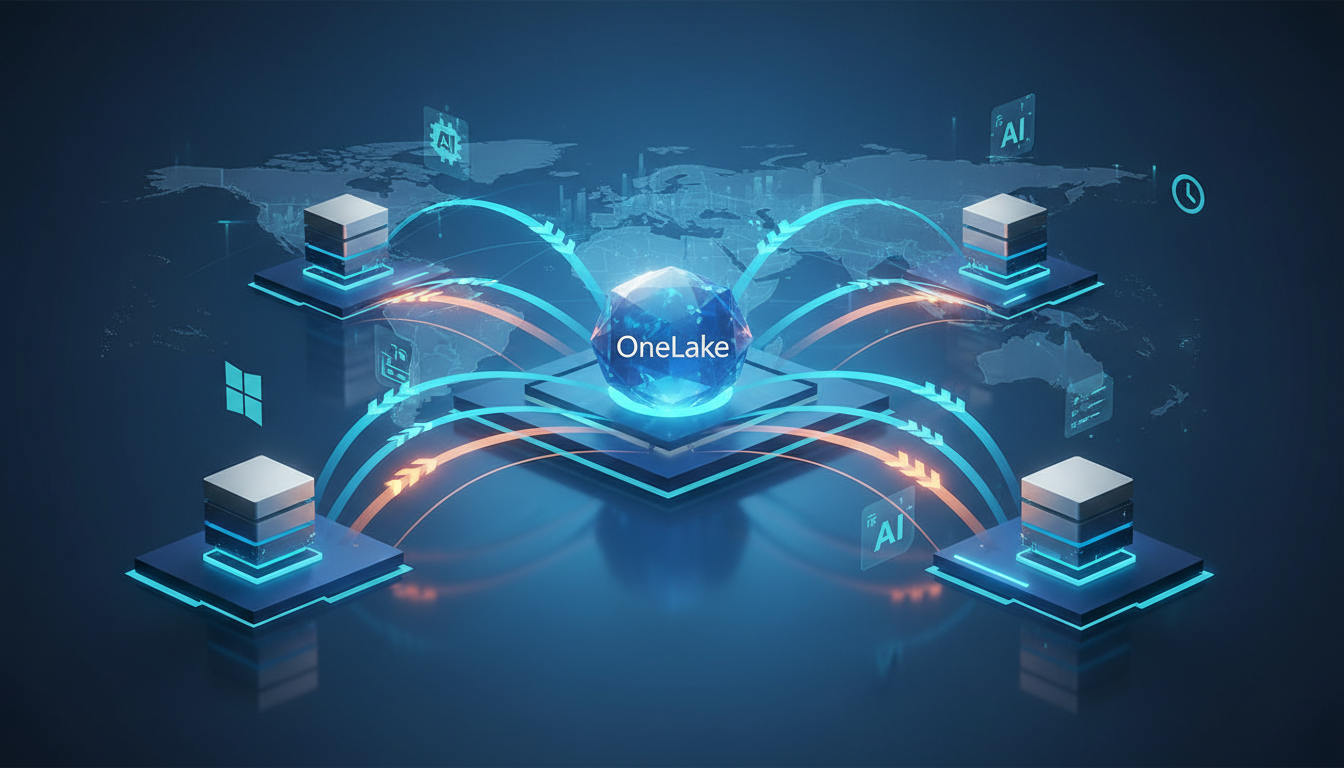
OneLake Shortcuts offer an innovative capability within Microsoft Fabric, allowing organizations to access external data without physically copying it into OneLake. Instead of moving data, shortcuts create a logical reference to the source, presenting it within the Fabric Lakehouse while keeping it in its original location. This abstraction supports multiple sources, including Azure Data Lake Storage and Amazon S3, fundamentally changing data consumption dynamics.
Logical vs Physical Data Layers
By separating the physical storage layer from the logical access layer, OneLake Shortcuts facilitate a unified data fabric without the need for physical centralization. This decoupling eliminates redundant storage costs, synchronization challenges, and inconsistencies driven by duplication.
How OneLake Shortcuts Fit into Modern Data Architecture
From Data Movement to Data Virtualization
The shift from traditional ETL-driven architectures to virtualization-first models marks a significant evolution in data engineering. OneLake Shortcuts support a virtualization-first approach, maintaining data in its source system and applying compute dynamically through a logical layer.
Traditional ETL vs OneLake Shortcuts
| Aspect | Traditional ETL Approach | OneLake Shortcuts Approach |
|---|---|---|
| Data Movement | Requires copying data across systems | No data movement; logical access only |
| Storage Usage | High (multiple copies of the same dataset) | Minimal (single source of truth) |
| Pipeline Complexity | High (multiple ETL pipelines) | Low (shortcuts replace pipelines) |
| Data Latency | Batch-based delays | Near real-time access |
| Governance | Fragmented across copies | Centralized and consistent |
| Cost Impact | High storage + compute cost | Optimized cost structure |
| Scalability | Limited by pipeline overhead | Scales with distributed data sources |
| AI Readiness | Delayed data availability | Immediate access to fresh data |
Eliminating Redundant Pipelines and Storage Costs
Streamlining Data Engineering Workflows
OneLake Shortcuts provide immediate benefits by eliminating the need for redundant ETL pipelines, which traditionally required extensive monitoring and introduced multiple points of failure. Data engineers can now focus on creating shortcuts and applying transformations directly to source data, reserving pipelines for value-adding transformations only.
Cost Optimization at Scale
In cloud environments, storage costs scale linearly with data volume. By eliminating duplication, organizations can significantly reduce storage consumption, lower data transfer costs, and optimize compute usage.
Governance and Security Considerations
Maintaining Control Across Distributed Data
OneLake Shortcuts ensure robust governance through layered models, providing Fabric-level and source-level controls. This dual-layer governance ensures that data access remains authorized and policies are consistently enforced across environments, addressing the fragmentation issues prevalent in duplication-heavy architectures.
Supporting Multi-Cloud and Hybrid Data Strategies
Unified Access Across Environments
As modern enterprises operate across multiple cloud platforms, OneLake Shortcuts provide a unifying access layer, enabling seamless data integration without physical movement. This approach prevents vendor lock-in, maintains compliance, and reduces cross-cloud data transfer costs.
Conclusion
OneLake Shortcuts represent a transformative shift in enterprise data management, reducing costs, simplifying architectures, and enabling consistent governance across distributed ecosystems. By aligning with the future of data platforms and supporting AI and real-time analytics, OneLake Shortcuts offer a strategic advantage for organizations looking to optimize their data strategies. As data volumes continue to grow, minimizing data movement will be essential, and OneLake Shortcuts provide the foundation for this necessary transformation.
Saksham Gupta
Founder & CEOSaksham Gupta is the Co-Founder and Technology lead at Edubild. With extensive experience in enterprise AI, LLM systems, and B2B integration, he writes about the practical side of building AI products that work in production. Connect with him on LinkedIn for more insights on AI engineering and enterprise technology.