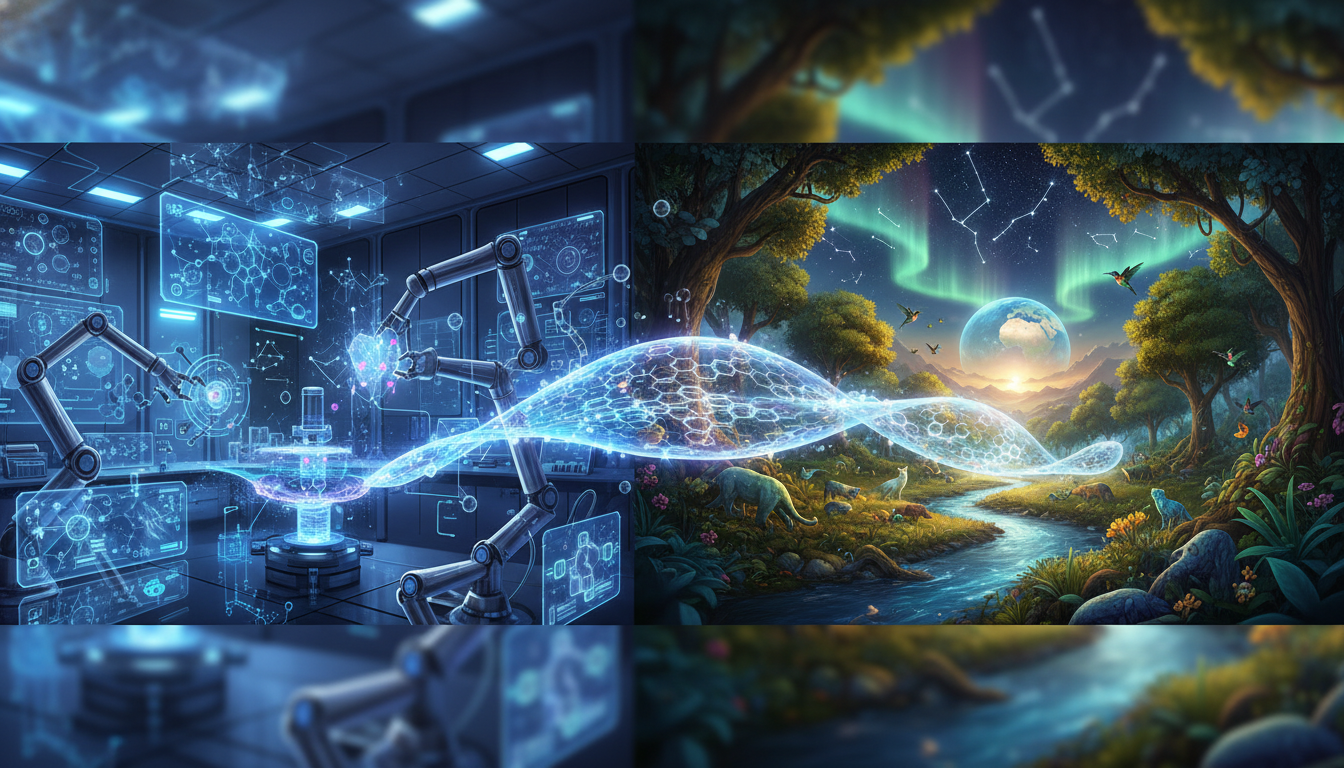
Unleashing AI: Transforming Scientific Discovery from Lab to Nature
Artificial Intelligence (AI) is no longer confined to the realms of poetry generation or culinary suggestions. Today, it's making significant strides in revolutionizing scientific discovery, offering new insights into the most complex questions about our world. From decoding the secrets of electrons to simulating natural processes, AI is at the forefront of modern science, accelerating research and enabling groundbreaking innovations.
Health: Advancing Care and Research
In the healthcare sector, AI has become an indispensable ally, not just automating routine tasks but transforming the way clinicians and researchers uncover medical insights. By analyzing large, unstructured datasets such as clinical notes and pathology slides, AI models can identify patterns that aid in early disease detection and inform personalized treatment plans.
Consider the PadChest-GR dataset, an innovative collection of chest X-rays developed by the University of Alicante and Microsoft. This dataset is a crucial tool for radiologists, improving image interpretation accuracy and aiding in the training of AI models. Additionally, tools like Microsoft AI Diagnostic Orchestrator (MAI-DxO) mimic the decision-making processes of a team of doctors, offering innovative solutions to complex medical cases with greater precision and reduced costs.
Discovery: Faster Scientific Insight
AI's role in scientific discovery is one of acceleration. By simulating natural processes and analyzing complex data at an unprecedented scale, AI enables researchers to explore hypotheses more efficiently. Microsoft's Discovery platform embodies this capability, using agentic AI to automate research tasks such as hypothesis formation and simulation execution.
For example, Discovery expedited the development of a new data center coolant prototype—a task that traditionally would have taken months—into just over a week. Similarly, AI models like the one developed for Density Functional Theory (DFT) are tackling long-standing challenges in materials science by accurately simulating electron behavior, with applications ranging from drug development to sustainable energy solutions.
Earth: New Tools for a Changing World
The application of AI in understanding Earth’s complex systems is bridging the gap between theoretical research and real-world application. Microsoft's Aurora model exemplifies this by going beyond traditional weather forecasting to model interactions between the atmosphere, land, and oceans. This enables scientists to better predict environmental events, thereby aiding communities in disaster preparedness and climate adaptation.
Moreover, AI is being harnessed to address sustainability challenges, such as the development of low-carbon cement by incorporating seaweed biomass, or the Intelligent Garden app, which communicates with urban trees to monitor their health. In Tanzania, AI-based analysis of drone footage assists conservationists in identifying and protecting endangered giraffes, demonstrating AI's potential in biodiversity conservation.
Quantum: Simulating Nature
Quantum computing is another frontier where AI is pushing the boundaries of scientific research. Unlike classical computers, quantum computers use qubits that can represent multiple values simultaneously, allowing for the exploration of numerous possibilities at once. This capability is particularly valuable for modeling intricate systems like chemical reactions and material behaviors.
Microsoft is at the forefront of integrating quantum physics with AI, as seen in the development of 4D geometric codes, which enhance the stability and reliability of quantum hardware. Collaborations with companies like Atom Computing are advancing the use of neutral-atom qubits, and the Majorana 1 chip represents a pioneering quantum architecture. These innovations provide researchers with new methodologies to tackle complex problems in health, materials science, and climate studies.
Energy: Smarter, Cleaner Power
In the realm of energy, AI is transforming production, storage, and utilization by optimizing existing systems and aiding in the creation of new ones. A collaboration between Microsoft and Nissan Motor Corporation exemplifies this, where AI predicts electric vehicle battery wear, reducing the need for extensive physical testing and promoting recycling over disposal.
AI is also pivotal in the pursuit of nuclear fusion energy, a clean power objective. By simulating complex physical processes, AI accelerates the identification of promising reactor designs, bringing this sustainable energy source closer to reality. In the U.S., Microsoft is exploring how AI can streamline the permitting process for advanced nuclear projects, which often encounter regulatory bottlenecks.
Conclusion
AI is proving to be a transformative force in scientific discovery, offering unprecedented capabilities to decode the complexities of our world. Its applications across health, earth sciences, quantum research, and energy demonstrate a future where scientific inquiry is not only faster but also more profound, with tangible impacts on our everyday lives. As AI continues to evolve, its partnership with science promises to unlock new potentials, fundamentally altering the landscape of discovery from the lab to nature.
Saksham Gupta
Founder & CEOSaksham Gupta is the Co-Founder and Technology lead at Edubild. With extensive experience in enterprise AI, LLM systems, and B2B integration, he writes about the practical side of building AI products that work in production. Connect with him on LinkedIn for more insights on AI engineering and enterprise technology.